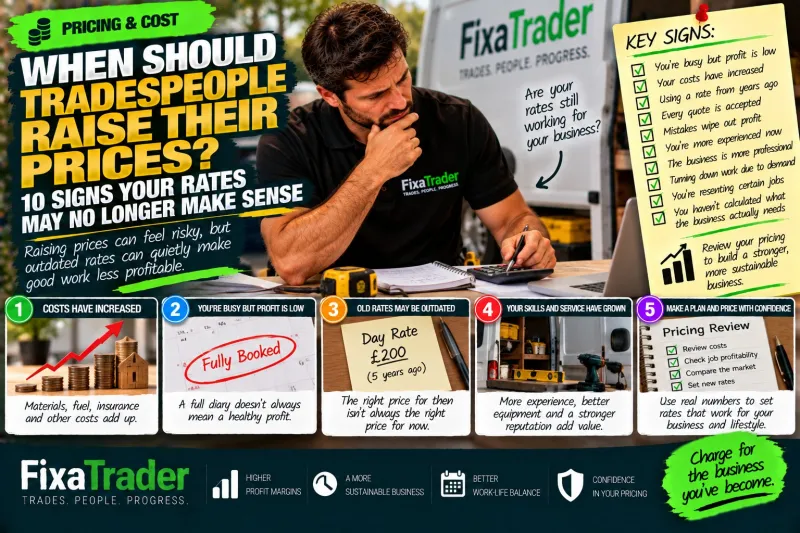
When Should Tradespeople Raise Their Prices? 10 Signs Your Rates May No Longer Make Sense
Nobody particularly enjoys telling customers that prices have gone up. For tradespeople, it can feel even more uncomfortable. You might have customers who have...
Nobody particularly enjoys telling customers that prices have gone up.
For tradespeople, it can feel even more uncomfortable.
You might have customers who have used you for years.
You know what competitors appear to charge.
You don't want enquiries disappearing because you've become “too expensive”.
So the easiest option is often:
Leave the price alone.
Another six months passes.
Materials increase.
Fuel costs more.
Insurance renews.
Your van needs replacing.
You're employing somebody now.
Jobs take more administration.
And somehow you're busier than ever while wondering where the money has gone.
Prices don't need to rise simply because another year has passed.
But they do need reviewing.
Because the right price for your business three years ago isn't automatically the right price today.
Here are ten signs it may be time to take another look.1. You're Busy, but the Money Doesn't Reflect It
This is one of the clearest warning signs.
Your diary is full.
You're working long days.
Customers keep calling.
There isn't much spare capacity.
Yet the financial results don't seem consistent with the amount of work you're doing.
That's worth investigating.
Being busy tells you there's demand for your time.
It doesn't tell you whether that time is priced correctly.
Look beyond turnover.
What remains after the actual costs of delivering the work?
If increasing workload produces very little improvement in what the business retains, your pricing may be part of the problem.2. Your Costs Have Increased but Your Prices Haven't
Businesses don't operate with fixed costs forever.
Consider what's changed since you last properly reviewed your rates.
Materials.
Fuel.
Vehicle costs.
Insurance.
Tools.
Software.
Storage.
Waste disposal.
Accountancy.
Training.
Employment costs.
Finance.
General business overheads.
Not every cost moves in the same direction and not every increase needs to be passed directly to customers.
But if your overall cost of delivering work has materially increased while your prices have remained unchanged, your margin is being compressed.
Eventually you're doing the same job for less economic return.3. You're Still Using a Rate You Chose Years Ago
Ask yourself a surprisingly useful question:
Why do you charge what you charge?
If the answer is:
“That's what I've always charged.”
you don't really have a pricing method.
You have a historical number.
Perhaps you chose £200 a day when you first became self-employed because another tradesperson told you that sounded reasonable.
Five years later, you're more experienced.
You own better equipment.
Your work is more efficient.
Your reputation has grown.
Your overheads have changed.
But the £200 has simply followed you through the years.
Past pricing can be a reference point.
It shouldn't automatically determine future pricing.4. Almost Every Quote Is Accepted Immediately
A high conversion rate sounds fantastic.
And generally, winning work is good.
But if virtually every customer accepts immediately, without meaningful price resistance, and your diary is permanently full, it's worth examining what that tells you.
It doesn't automatically prove you're too cheap.
Perhaps you have an exceptional reputation.
Maybe your leads are highly qualified.
Perhaps customers come almost entirely through strong referrals.
But price is one variable worth considering.
Businesses sometimes worry that increasing prices will cause them to lose work when they already have far more demand than they can accommodate.
You don't necessarily need every enquiry to become a job.
You need enough of the right enquiries to build a healthy business.5. Small Mistakes Wipe Out the Profit
Imagine a job goes perfectly.
It earns a reasonable return.
Then one thing goes wrong.
You need another half-day.
A material has to be replaced.
You make an extra journey.
Suddenly almost all of the profit disappears.
Some risk is unavoidable.
But if your pricing only works when every project goes perfectly, there may not be enough margin for the realities of running a trade business.
Jobs involve uncertainty.
Traffic happens.
Suppliers make mistakes.
Measurements occasionally need revisiting.
Tools break.
Customers change arrangements.
Not every problem should simply be added to the customer's invoice.
Your pricing needs enough resilience for the ordinary costs and risks the business itself carries.6. You've Become Much Better at What You Do
Experience has value.
Perhaps three years ago a particular job took you two days.
Today you can produce a better result in one.
Should the customer now pay half as much because you've become more efficient?
Not necessarily.
Customers are paying for an outcome, and depending on the pricing structure, your expertise may allow you to produce that outcome more efficiently.
This is one weakness of thinking exclusively in terms of:
hours × rate.
The fastest tradesperson isn't necessarily providing the least valuable service.
Years of experience can be precisely why the work gets completed quickly and correctly.
As your capability grows, your pricing model should at least be reviewed alongside it.7. The Business Has Become More Professional
Your service today may not resemble the business you originally priced.
Perhaps you now provide:
Better communication.
Detailed quotations.
Professional invoicing.
Improved insurance cover.
Higher-quality tools.
Better vehicles.
Project documentation.
Aftercare.
Qualifications.
Additional staff.
Stronger guarantees.
More reliable scheduling.
None of those things is free.
A professional service has infrastructure behind it.
Customers don't only pay for the minutes your hands are physically touching their property.
The cost of providing a dependable service exists before and after the site visit.8. You're Constantly Saying No Because the Diary Is Full
Being booked well ahead can be a positive sign.
But persistent excess demand should tell you something.
Suppose you can realistically complete 20 jobs per month.
You're receiving enough suitable enquiries for 35.
You have several options.
Increase capacity.
Improve scheduling.
Become more selective.
Change the type of work you accept.
Or review pricing.
Sometimes the business doesn't need more leads.
It needs to extract a sustainable return from the capacity it already has.
That doesn't mean doubling your prices the moment you're busy for two weeks.
Seasonality and temporary spikes matter.
Look for a consistent pattern.9. You're Resenting Certain Jobs Before You've Even Started
This is an interesting warning sign.
A customer accepts the quote.
You look at the diary.
And your immediate reaction is:
“I really don't want to do that for that price.”
Pay attention to that.
Perhaps the job itself isn't a good fit.
Maybe travel is the problem.
Maybe the work is unpleasant.
Maybe it carries more risk than your pricing recognises.
Or perhaps you simply aren't charging enough for that particular service.
If the same category of work repeatedly creates that reaction, analyse it separately.
You don't necessarily need one universal percentage increase across the entire business.
Some services may be priced perfectly well.
Others may need substantial adjustment.10. You Haven't Calculated What the Business Actually Needs to Earn
This is the big one.
Pricing shouldn't begin with:
“What can I get away with charging?”
Nor should it begin with:
“What's everyone else charging?”
Start with the economics of your own business.
How much does it cost to operate?
How many genuinely chargeable days or hours do you have?
What income does the business need to generate?
What provision is needed for tax and other obligations?
What level of profit makes the business worthwhile and sustainable?
How much non-billable time exists?
Once you understand those numbers, you can assess whether your current pricing has any realistic chance of delivering them.Your Day Rate Isn't Based on 365 Days
This catches people out when they first become self-employed.
Suppose you decide how much you'd like to earn annually and divide it by 365.
That doesn't reflect how a trade business actually operates.
You won't invoice customers for every day of the year.
There are:
Weekends.
Holidays.
Illness.
Quoting days.
Admin.
Training.
Vehicle maintenance.
Supplier runs.
Gaps between projects.
Callbacks.
Bad weather for some trades.
And other non-billable time.
Even during a full working week, not every hour is necessarily chargeable.
Your billable time has to support the non-billable parts of running the business too.Don't Copy Another Tradesperson's Rate Blindly
You hear another tradesperson charges £350 per day.
Should you charge £350?
There's nowhere near enough information to answer that.
They might have completely different:
Overheads.
Travel.
Experience.
Equipment.
Insurance.
Employees.
Type of customer.
Job mix.
Geographic market.
Productivity.
And business goals.
Even two apparently similar electricians or decorators in the same town can have very different cost structures.
Competitor pricing is useful market information.
It isn't your business plan.Raising Prices Doesn't Mean Increasing Everything Equally
A pricing review might reveal that your headline labour rate isn't actually the main problem.
Perhaps:
Small jobs need a higher minimum charge.
Travel outside your core area needs pricing differently.
One particular service is consistently underestimated.
Material handling isn't accounted for.
Emergency work disrupts the diary far more than ordinary work.
Complex quotation work consumes too much unpaid time.
Or jobs requiring multiple visits are less profitable than expected.
A sophisticated pricing review asks:
Where is the business losing margin?
not simply:
What percentage should I add to everything?What About Existing Customers?
This is where many tradespeople hesitate.
You may have a customer you've worked for since you started.
They're used to your old price.
That relationship has value.
But it doesn't necessarily mean you should charge a financially unsustainable rate forever.
How you handle increases depends on the relationship and type of work.
For regular customers, clear notice can be appropriate.
For individually quoted project work, current pricing can simply be reflected in future quotations.
The key is not to create confusion by unexpectedly changing an already agreed price.
A new rate for future work is different from changing the price of work you've already contracted to complete.Don't Apologise for Having a Sustainable Business
There is a difference between explaining a price and sounding embarrassed by it.
You don't need to send customers a breakdown of every insurance premium, fuel receipt and tool purchase to justify what you charge.
Your price is what your business requires to provide the service on the terms offered.
Customers are free to compare alternatives.
Your responsibility is to make the price and scope clear before they commit.
A business that cannot afford to keep operating isn't ultimately useful to customers either.But Don't Assume You Can Charge Anything
The opposite extreme isn't sensible either.
Costs have increased, therefore customers must accept whatever number you choose?
No.
The market still matters.
Customer expectations matter.
The value of the service matters.
Your positioning matters.
The availability of alternatives matters.
If your new price causes almost every suitable customer to walk away, that's useful information.
Pricing is a balance between your economics and the market you're serving.Test the Change With Real Numbers
Instead of emotionally deciding:
“I need to put my prices up.”
use data.
Look at a recent sample of jobs.
For each one, record:
Quoted price.
Actual labour time.
Travel.
Materials.
Other direct costs.
Number of visits.
Unexpected additional time.
Callback time.
And what was left after those costs.
Patterns should begin to emerge.
You may discover that your pricing is broadly healthy.
Great.
You may discover that only one type of job is a problem.
Or you may realise the business has been systematically underpricing its time.
Either way, you're making the decision using evidence.Price Reviews Should Be Normal Business Maintenance
Tradespeople maintain tools.
Service vans.
Replace worn equipment.
Renew insurance.
Update qualifications.
Pricing deserves the same attention.
You don't need to change prices constantly.
But reviewing them periodically prevents years of cost increases accumulating unnoticed.
A useful review might ask:
Have our costs changed?
Has our service changed?
Has our skill level changed?
Has demand changed?
Which jobs make money?
Which jobs don't?
Are we achieving the return the business needs?
Then decide whether anything actually needs adjusting.Being More Expensive Isn't Automatically Losing
Suppose increasing your pricing means you complete slightly fewer jobs.
That initially sounds negative.
But imagine those jobs generate similar or greater overall profit while giving you:
More time for quotations.
More capacity for good customers.
Less pressure on the diary.
More room for unexpected problems.
And less need to work every available hour.
That's not necessarily a worse business.
Revenue, job count and working hours are only part of the picture.
The objective is a business that works economically and practically.Your Price Should Evolve With Your Business
The amount you charged when you first started was based on the business you had then.
Perhaps you had:
Few customers.
Limited equipment.
Very little reputation.
Lower overheads.
And plenty of spare capacity.
Five years later, the business may be completely different.
Your experience has changed.
Your service has changed.
Your costs have changed.
Your demand has changed.
Your reputation has changed.
So periodically ask whether the number on the quote has changed with them.
You don't need to increase prices because somebody on social media told you that you're “worth more”.
You need to understand what it genuinely costs to deliver your work, what return the business requires and whether the prices you're currently charging still make sense.
The question isn't simply whether customers will accept a higher price — it's whether your current price still supports the business you've actually become.
0 Comments
No comments yet — be the first to share your thoughts.