Should You Repair or Replace? How to Decide When Something in Your Home Goes Wrong
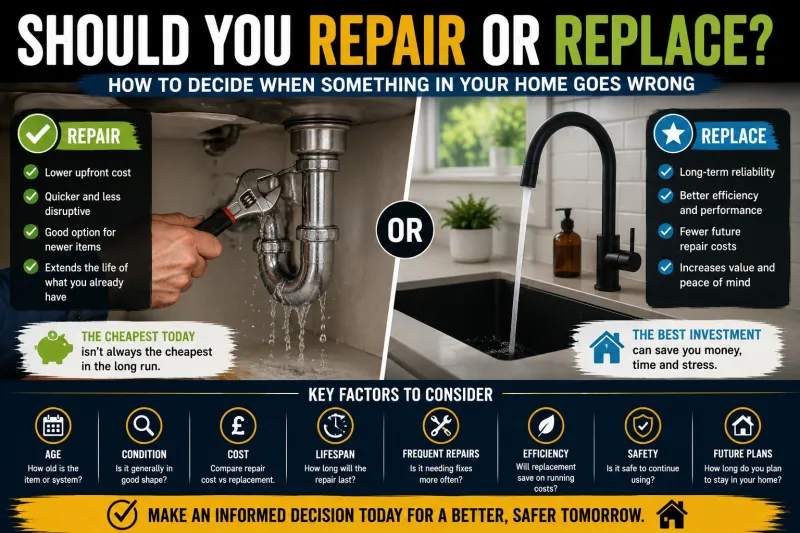
Something breaks in your home. The first question is usually: “How much will it cost to fix?” But there is often a second question that matters just as much: “I...
But there is often a second question that matters just as much:
“Is it actually worth fixing?”
From boilers and windows to appliances, roofing, fencing and plumbing fixtures, homeowners regularly face the same decision.
Repair the existing problem?
Or spend more now and replace the item altogether?
There isn't a universal answer.
The cheapest option today isn't necessarily the cheapest option over the next five years. Equally, replacing something simply because it's old can mean spending thousands of pounds unnecessarily.
The better decision usually comes from looking at the bigger picture.1. Start With the Cost of the Repair
The obvious place to begin is the repair itself.
How much will it cost to put the problem right?
But don't compare the repair cost with the replacement price alone.
You need to understand what the repair actually achieves.
Imagine something costs £300 to repair and £1,200 to replace.
At first glance, the repair seems like the obvious choice.
But there is a major difference between:
£300 to repair something likely to work reliably for another five years
and:
£300 to repair one fault on something likely to develop another expensive problem six months later.
The price only tells you part of the story.
Ask what condition the rest of the item or system is in.2. Consider Its Age
Age doesn't automatically mean something needs replacing.
A well-maintained older installation may still have years of useful life left.
But age can affect the economics of a repair.
Older equipment may have:
More worn components
Reduced efficiency
Harder-to-find replacement parts
Several areas approaching failure
Outdated technology
Previous repairs
That's why knowing the approximate age can be useful when speaking to a tradesperson.
A relatively inexpensive repair on something otherwise in good condition can make perfect sense.
Repeatedly repairing something near the end of its practical life may not.3. Look at the Overall Condition, Not Just the Fault
A broken component can distract attention from everything around it.
Suppose one section of a timber fence has failed.
If the remaining fence is solid, repairing the damaged section could be entirely sensible.
If multiple posts are rotten, several panels are deteriorating and the whole fence is leaning, repairing one section may simply move the problem somewhere else.
The same thinking can apply throughout a property.
Don't ask only:
“Can this particular fault be repaired?”
Ask:
“What condition is the rest of it in?”
That gives you a much better idea of whether you're preserving something worthwhile or postponing an inevitable replacement.4. Think About Previous Repairs
One repair isn't necessarily a concern.
Repeated repairs are different.
If you've called someone out three times in two years for problems with the same item or system, add those costs together.
Homeowners sometimes assess each repair individually.
£120 doesn't seem too bad.
Then £180.
Then another £150.
Individually, each decision may feel sensible.
Collectively, you've spent £450 and still own the same unreliable item.
Keep a basic record of significant repairs around your home.
It can make future decisions much easier.5. Ask How Long the Repair Is Expected to Last
Nobody can guarantee exactly when something will fail.
But a tradesperson may be able to explain whether the proposed repair is expected to be a lasting solution or more of a temporary measure.
That's valuable information.
There is nothing inherently wrong with a temporary repair.
Sometimes you simply need to make something safe or functional until a larger project can be arranged.
The important thing is knowing that's what you're paying for.
If you're spending £500 believing a problem has been permanently solved when the contractor expects replacement to be necessary relatively soon, you haven't been given the information needed to make a good decision.
Ask.
“If we repair this, realistically, what would you expect to happen next?”6. Factor In Running Costs
The calculation isn't always just:
Repair cost vs replacement cost.
Sometimes a newer replacement can change ongoing costs too.
That can be relevant with things such as heating equipment, lighting, windows, insulation and certain electrical equipment.
But be careful with dramatic savings claims.
A more efficient replacement doesn't automatically mean replacing a perfectly functional item will pay for itself quickly.
If replacing something costs £4,000 and saves £100 a year, the financial calculation looks very different from a £1,000 replacement saving £300 annually.
Ask for realistic figures where possible.
Then do the maths.7. Consider Parts Availability
Some older products remain straightforward to repair.
Others become increasingly difficult.
Manufacturers discontinue parts.
Components become expensive.
Specialist knowledge becomes harder to find.
A repair may technically be possible but economically questionable because one obsolete component costs a disproportionate amount.
If parts availability is becoming an issue, ask the tradesperson whether future repairs are also likely to become difficult.
That may influence whether spending heavily on the current repair makes sense.8. Safety Can Override the Financial Calculation
Sometimes repair versus replacement isn't primarily a money question.
It's a safety question.
If an electrical installation, gas appliance, structural component or other safety-critical part of the property is considered unsafe, the appropriate solution should be determined by someone competent to assess it.
Don't continue using something potentially dangerous simply because replacement is expensive.
And be wary of trying to diagnose safety-critical faults yourself based on an online article or video.
Saving money matters.
Protecting the people inside the property matters more.9. Think About What You're Planning to Do With the Property
Your wider plans can affect the decision too.
Are you renovating the room next year anyway?
Planning an extension?
Replacing the kitchen?
Moving house?
Upgrading the heating system?
If a larger project is already planned, spending heavily on something that will soon be removed may make little sense.
A safe temporary repair could potentially be more appropriate.
On the other hand, delaying necessary work simply because you might renovate several years from now could create additional problems.
Consider your actual plans rather than hypothetical ones.10. Don't Assume the Tradesperson Who Recommends Replacement Is Upselling You
It's reasonable to question a large expense.
You should understand why replacement is being recommended.
But replacement isn't automatically an attempt to sell you something more expensive.
Sometimes repairing genuinely doesn't make economic sense.
A good professional should be able to explain the reasoning.
Ask:
What's actually failed?
Can it be repaired?
What would the repair cost?
What condition is everything else in?
How long might the repair reasonably last?
Why are you recommending replacement instead?
The quality of the explanation matters.When Is Repair Usually Worth Considering?
Repair can be particularly attractive when the underlying item is still in good condition, the fault is isolated, suitable parts remain available and the cost is relatively modest compared with replacement.
It can also make sense when replacement would involve significant disruption for little additional benefit.
The important point is that you're repairing something that still has useful life left.When Does Replacement Start Making More Sense?
Replacement becomes more compelling when several problems begin stacking up.
The item is approaching the end of its expected life.
Repairs are becoming frequent.
Parts are difficult to obtain.
Its condition has deteriorated generally.
Running costs are high.
The repair itself is expensive.
Or the replacement provides meaningful improvements that you genuinely need.
There doesn't have to be one decisive factor.
Often it's the combination that changes the calculation.Get More Than One Opinion on Expensive Decisions
If you're being advised to spend several thousand pounds replacing something and the situation isn't an emergency, getting another professional opinion can be worthwhile.
That doesn't mean automatically choosing whichever person gives you the cheapest answer.
You're looking for consistency.
If two competent professionals independently identify the same underlying problem and recommend similar solutions, you have more information to work with.
If their recommendations are completely different, ask why.
A good quotation should help you understand what you're buying and why.The Cheapest Decision Isn't Always the Lowest Price
Home maintenance decisions become expensive when we look only at today's bill.
A £200 repair can be excellent value.
It can also be £200 towards something you'll replace three months later.
A £2,000 replacement can be unnecessary.
It can also prevent you spending £800 repeatedly keeping an unreliable system alive.
The goal isn't always to repair.
And it isn't always to replace.
The goal is to get the most useful life from the money you're spending.
Before making the decision, look beyond the immediate fault.
Consider the cost, age, condition, reliability, safety and what you're likely to spend next.
That's when “repair or replace?” becomes a much easier question to answer.
0 Comments
No comments yet — be the first to share your thoughts.