Estimate vs Quote: What’s the Difference and Which One Should You Ask a Tradesperson For?
You've described the job and the tradesperson says: “I reckon you're looking at around £800.” Is that the price? Or just an indication? Later, you receive a doc...
You've described the job and the tradesperson says:
“I reckon you're looking at around £800.”
Is that the price?
Or just an indication?
Later, you receive a document saying:
Quotation: £1,050.
Why has the number changed?
One possibility is that the first figure was an estimate, while the second was a quote based on a clearer understanding of the work.
Customers often use those terms interchangeably, but the distinction matters.What Is an Estimate?
An estimate is essentially an informed prediction of what a job is likely to cost.
It can be useful when the exact amount of work isn't yet known.
Imagine a tradesperson looks at a problem and says:
“Based on what I can see, I'd estimate somewhere around £600–£800.”
That gives the homeowner a useful idea of the likely cost without pretending every detail is already known.
An estimate may be based on assumptions about:
How long the work will take
Material quantities
What will be found once work begins
Access to the area
The condition of existing installations
The amount of preparation required
If those assumptions change, the eventual cost can change too.What Is a Quote?
A quotation is generally much more definite.
Rather than:
“It'll probably cost around £1,500.”
the tradesperson might provide:
“The quoted price for the agreed work is £1,650.”
That price should relate to a defined scope of work.
This is why a useful quote shouldn't contain only a number.
It should make reasonably clear what has actually been priced.
For example:
Removal of existing flooring.
Preparation of the subfloor.
Supply of specified materials.
Installation.
Trims.
Waste removal.
Finishing.
Total: £X.
Now both sides have something concrete to refer back to.Why Can't Every Job Be Quoted Immediately?
Because sometimes the tradesperson simply doesn't know enough yet.
A homeowner might send:
“How much to fix a leaking shower?”
There could be a straightforward failed seal.
There could be damaged pipework.
Water might be getting through the enclosure.
The tray could be moving.
The problem might not even originate from the shower.
Giving an exact fixed price from that description would require guessing what the fault actually is.
In circumstances like these, an estimate, diagnostic visit or initial inspection can be more appropriate than false precision.
Price certainty requires scope certainty.Why Might an Estimate Change?
Suppose a decorator estimates a room based on photographs.
When they arrive, they discover considerably more preparation is required than expected.
Or a landscaper estimates excavation work before discovering difficult ground conditions.
Perhaps a plumber provides an initial estimate before gaining access to concealed pipework.
The final price being different doesn't automatically mean the original estimate was dishonest.
The useful question is:
Why did it change?
A professional should be able to explain the significant difference.Does a Quote Mean the Price Can Never Change?
Not necessarily.
A quote relates to the work that was actually agreed.
Then the project changes.
The customer decides to add another room.
A different product is selected.
Additional work is requested.
Or previously concealed conditions are discovered that genuinely fall outside the original scope.
Those aren't necessarily reasons to expect the original price to cover unlimited additional work.
This is where variations become important.
If the scope changes, the price may need to change with it.
Where practical, the additional work and cost should be discussed before it proceeds rather than appearing as a surprise at the end.The Cheapest Quote Isn't Necessarily the Same Job
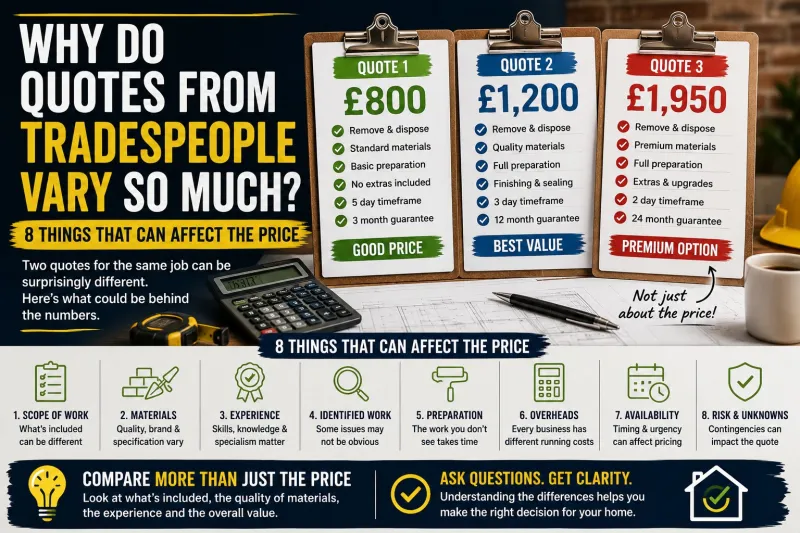
This is one of the biggest mistakes homeowners can make when collecting prices.
You receive:
Quote A — £3,800
Quote B — £4,400
Quote C — £5,100
It looks like you have three prices for the same thing.
But look closer.
Quote A excludes waste removal.
Quote B includes it.
Quote C includes a higher specification of materials and additional preparation.
You're no longer comparing £3,800 with £4,400 and £5,100.
You're comparing three different packages of work.
Before comparing the price, compare the scope.Watch for Allowances and Provisional Figures
Larger projects sometimes contain items that can't yet be priced with complete certainty.
For example, a quotation may include an allowance for a product the customer hasn't selected yet.
That's useful—but you need to recognise what it means.
If £500 has been allowed for a particular item and you later choose something costing £900, the overall project cost may change accordingly.
Likewise, certain work may depend on conditions that can't reasonably be confirmed until something is opened, removed or exposed.
Ask what figures are fixed and what figures remain dependent on later decisions or discoveries.Tradespeople Should Be Clear Too
This isn't only something homeowners need to understand.
For tradespeople, vague language can create problems.
If you send a customer a message saying:
“£2,000 all in.”
what have they reasonably understood?
Was that an estimate?
A fixed quote?
Did it include materials?
VAT where applicable?
Waste?
Making good?
The clearer you are when providing the price, the less room there is for disagreement later.
Even for relatively small jobs, writing down the basic scope can protect both sides.When Should a Homeowner Ask for an Estimate?
An estimate can make sense when:
The job is still at an early planning stage.
You want to understand whether something is broadly affordable.
Important details haven't been decided.
The underlying problem hasn't been fully diagnosed.
Or the scope contains genuine uncertainty.
Perhaps you're considering renovating a room next year and simply want to know whether you're thinking about £2,000 or £20,000.
You may not need a detailed quotation yet.
You need a realistic starting point.When Should You Ask for a Quote?
Once you're seriously considering going ahead and the scope can be properly defined, greater certainty becomes more valuable.
For substantial work, you generally want something in writing that makes clear:
What is being done?
What is included?
What isn't included?
What products or specifications have been assumed?
What is the agreed price?
How will legitimate changes be handled?
The larger the financial commitment, the more important that clarity becomes.Don't Force Certainty Where None Exists
Sometimes homeowners understandably want one answer:
“Just tell me exactly what it will cost.”
But a confident number isn't automatically an accurate number.
If a tradesperson hasn't inspected the problem, doesn't know what is behind a surface or hasn't received enough information to define the job properly, insisting on an exact price can encourage guesswork.
A better response may genuinely be:
“I can't give you an accurate fixed price until I've seen it.”
That's not necessarily evasive.
Sometimes it's the most responsible answer available.Ask One Simple Question
If somebody gives you a price and you're unsure what it represents, ask:
“Is that an estimate or the quoted price for the agreed work?”
That one sentence can remove a surprising amount of ambiguity.
Then make sure you understand what assumptions sit behind the figure.
Because the important question isn't only:
“How much?”
It's also:
“How certain is that price, and exactly what does it include?”
A useful price doesn't just tell you the number — it tells you what that number actually means.
0 Comments
No comments yet — be the first to share your thoughts.