How to Describe a Job to a Tradesperson: The Information That Helps You Get a Better Response
You need a tradesperson. You find someone who looks suitable and send them a message: “Hi, how much would you charge to fix my bathroom?” There's nothing wrong...
You find someone who looks suitable and send them a message:
“Hi, how much would you charge to fix my bathroom?”
There's nothing wrong with asking.
But there's also very little information for the tradesperson to work with.
What needs fixing?
A leaking tap?
A cracked tile?
A shower that has stopped working?
A complete bathroom renovation?
And where is the property?
When do you need the work?
Do you already have the materials?
A tradesperson doesn't necessarily need every detail before responding, but giving them the right information at the beginning can make the conversation considerably easier.
It can also help you find out much faster whether they're actually the right person for the job.Why the First Message Matters
Tradespeople can receive enquiries while they're:
On site.
Driving between jobs.
Buying materials.
Preparing quotations.
Dealing with existing customers.
Running the rest of their business.
A clear enquiry is easier to assess quickly.
Instead of several messages going backwards and forwards just to establish the basics, the tradesperson can immediately understand what you're looking for.
They may be able to tell you:
Whether they undertake that type of work.
Whether they cover your area.
When they're likely to be available.
Whether they need photographs.
Whether a site visit will be required.
Or whether another type of specialist would be more appropriate.
That's useful for both sides.1. Explain What You Actually Need
Start with a simple description of the work.
You don't need to know the technical terminology.
In fact, it's usually better to describe what you're seeing or what you want done rather than trying to diagnose the problem yourself.
For example:
“There is water appearing underneath the kitchen sink whenever we use the tap.”
is more useful than:
“I think the waste compression fitting has failed.”
You may be correct.
But you don't need to be.
Describe the symptoms and let the appropriate professional investigate the cause.
For planned work, explain the outcome you're looking for.
Instead of:
“Need some electrical work.”
try:
“We're renovating our kitchen and need additional sockets installed before the new units go in.”
Immediately, the scope becomes clearer.2. Include Your Location
This sounds obvious, but it's easily forgotten.
A tradesperson needs to know where the job is.
You don't necessarily need to provide your complete address in the first message.
Your town, area or postcode district may be enough initially.
For example:
“The property is in TW7.”
That allows the business to establish whether the job falls within its normal working area.
This becomes particularly important if you've discovered the tradesperson online rather than through somebody local.
A business may appear in search results even though your property is considerably outside the area it normally covers.3. Explain Whether It's Urgent
There's a big difference between:
“I'd like this done sometime next month.”
and:
“Water is currently coming through the ceiling.”
If the problem is genuinely urgent, say so.
That helps the tradesperson prioritise the enquiry and tell you whether they can realistically respond quickly enough.
But try to distinguish between something that is inconvenient and something that is genuinely an emergency.
An emergency may involve an immediate risk to people or property.
For example, uncontrolled water, suspected gas problems or potentially dangerous electrical issues may require urgent action.
If there is an immediate danger, don't wait around sending messages to multiple businesses looking for the cheapest quotation.
Follow appropriate emergency or safety guidance and contact the relevant qualified professional or emergency service where necessary.4. Send Useful Photographs
Photographs can be extremely helpful.
They won't always allow somebody to diagnose the problem remotely, but they can give useful context.
Try to include both:
A wider photograph showing the area
and:
A closer photograph showing the specific problem.
If you're asking about damaged brickwork, for example, one extremely close photograph of a crack may not show where on the building it is.
Likewise, a photograph taken from twenty metres away may not show the damage properly.
Both together are much more useful.
Photographs can also help a tradesperson understand access, existing installations and the approximate scale of the job.5. Mention Anything You've Already Tried
If you've already attempted something, tell them.
Perhaps you've:
Reset the boiler.
Changed a fuse.
Cleared a blockage.
Turned off a valve.
Applied temporary sealant.
Had somebody else inspect the problem.
Or replaced a component.
That information may be relevant.
It can prevent the tradesperson repeating troubleshooting steps unnecessarily and may provide clues about what's happening.
Be straightforward about DIY attempts too.
A professional would generally rather know that something has been dismantled or altered before they start working on it.6. Tell Them About Previous Problems
Has this happened before?
That's useful information.
Imagine a customer reports:
“The boiler has lost pressure.”
Compare that with:
“The boiler has lost pressure four times in the last two months. I've been topping it back up, but it keeps happening.”
Those are different situations.
The same applies to:
Recurring blocked drains.
Repeated electrical trips.
Cracks that continue growing.
Damp that returns after decorating.
Roof leaks that only appear during particular weather.
Intermittent faults.
Patterns matter.
Even if you don't know what they mean, tell the tradesperson what you've noticed.7. Explain What Access Is Like
Access can significantly affect a job.
Is the boiler inside a cramped cupboard?
Is the garden accessible only through the house?
Is the property on the fourth floor?
Is there somewhere to park?
Is the electrical consumer unit difficult to reach?
Will scaffolding potentially be required?
Is the property occupied?
Are there restrictions on working hours?
You won't necessarily know which details matter.
But if there's something unusual about accessing the job, mention it.
A straightforward task can become considerably less straightforward when the working area is difficult to reach.8. Be Clear About the Scope of Planned Projects
If you're contacting someone about a larger project, provide enough information for them to understand what you're trying to achieve.
For example, if you want a room decorated:
How large is it approximately?
Walls only, or ceilings too?
Woodwork?
Are the walls currently in good condition?
Is wallpaper being removed?
Will the room be empty?
Are you supplying the paint?
You don't need to produce a professional specification.
But the difference between “paint bedroom” and a reasonably clear description could substantially change the amount of work involved.
For larger renovations, plans, measurements or specifications may eventually be necessary.9. Mention Your Timescale
If you have a deadline, communicate it early.
Maybe you're:
Moving into the property.
Preparing to sell.
Waiting for another trade.
Having a kitchen delivered.
Working around a tenancy.
Trying to complete work before an event.
The tradesperson may have availability in three weeks.
If you absolutely need the work completed next Tuesday, there's little benefit in spending several days discussing the job before discovering the schedules don't match.
Equally, if you're flexible, say that too.
Flexibility can sometimes make a job easier to schedule.10. Don't Expect an Accurate Price From One Sentence
Some jobs can be priced relatively easily from a description and photographs.
Others can't.
There may be too many unknowns.
A tradesperson might need to:
Inspect the problem.
Take measurements.
Check existing installations.
Understand access.
Determine what materials are required.
Investigate the underlying cause.
Or discuss exactly what finish you want.
If somebody says they need to see the job before giving you a proper quotation, that doesn't necessarily mean they're making the process difficult.
Sometimes an accurate price simply requires more information.A Better First Message
You don't need to send an essay.
Something like this can provide plenty to start with:
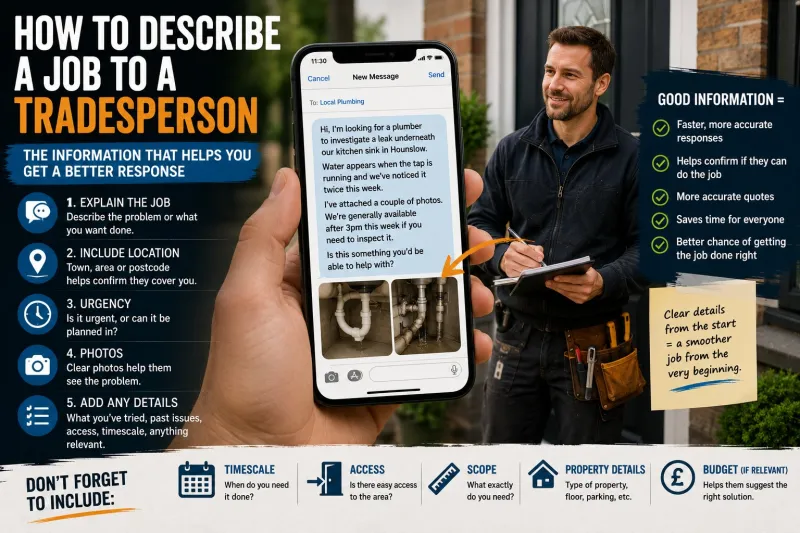
Hi, I'm looking for a plumber to investigate a leak underneath our kitchen sink in Hounslow. Water appears when the tap is running and we've noticed it twice this week. I've attached a couple of photos. We're generally available after 3pm this week if you need to inspect it. Is this something you'd be able to help with?
That message tells the tradesperson:
What type of job it is.
Where it is.
What's happening.
How long it has been happening.
That photographs are available.
And when the customer is available.
They may still need more information.
But you've made it considerably easier to start the conversation.What You Don't Need to Know
One important point:
You aren't expected to diagnose the problem.
That's why you're contacting a professional.
You don't need to know the name of every component.
You don't need to understand building regulations.
You don't need to know exactly what materials are required.
And you shouldn't pretend to know the solution because you watched three videos online.
Your job is simply to communicate what you know.
What can you see?
What can you hear?
When does it happen?
When did it start?
What are you trying to achieve?
The tradesperson can take it from there.Good Communication Works Both Ways
Customers understandably expect tradespeople to communicate professionally.
But providing a useful enquiry helps the tradesperson do exactly that.
The clearer the initial information, the easier it becomes for them to decide whether they're suitable, what additional information they need and what should happen next.
That doesn't guarantee an instant quotation.
And it doesn't mean photographs can replace a proper inspection.
It simply removes unnecessary guesswork.
You don't need to speak like a tradesperson to contact one.
Describe the problem clearly, provide the useful details you know, and let the professional work out the rest.
0 Comments
No comments yet — be the first to share your thoughts.