What Should a Good Tradesperson Quote Actually Include?
Getting a quote for work around your home can sometimes be confusing. You might receive three prices for what appears to be the same job, only to discover that...
Getting a quote for work around your home can sometimes be confusing.
You might receive three prices for what appears to be the same job, only to discover that each tradesperson has described the work differently.
One quote might simply say:
"Bathroom refurbishment — £6,500."
Another could run several pages and explain exactly what is included, which materials will be used, how long the work is expected to take and what happens if something changes.
The difference isn't necessarily that one tradesperson is more expensive than another.
It may simply mean the quotes aren't describing the same thing.
A good quote should give you enough information to understand what you're buying, what you're paying for and what happens next.
Here are some of the things worth looking for.1. A Clear Description of the Work
The first thing a quote should establish is what the tradesperson has actually agreed to do.
Rather than simply saying "kitchen work" or "roof repair", a useful quote should describe the scope of the job in reasonable detail.
For example, a bathroom quote might specify whether it includes removing the existing suite, preparing surfaces, installing new fixtures, tiling, plumbing and finishing.
The more substantial the project, the more important this becomes.
If you aren't sure whether something is included, ask before accepting the quote.
It's much easier to clarify the scope beforehand than argue about it once the work has started.2. Labour Costs
A quote should make it reasonably clear how labour is being accounted for.
Depending on the type of work, this might be presented as a single labour cost, a daily or hourly rate, or incorporated into the overall project price.
There isn't necessarily one correct format.
What's important is that you understand what you're paying for and how the figure relates to the work being proposed.3. Materials and Products
Materials can make a significant difference to the final cost of a project.
A quote might specify particular products or materials, provide allowances, or simply describe the required materials.
For larger projects, it can be useful to know whether items such as fixtures, fittings, flooring, paint or other products are included in the quoted price.
This is particularly important when comparing quotes.
A £5,000 quote that includes premium materials isn't necessarily comparable with a £4,000 quote where the customer is expected to purchase several items separately.4. What Isn't Included
This is one of the most overlooked parts of a quote.
A good quote isn't only about what is included. It should also make important exclusions clear.
For example, a quote might exclude:
Certain materials
Specialist surveys
Structural work
Making good after additional work
Waste removal
Decorating
Planning or specialist professional fees
Not every possible exclusion needs a paragraph of its own.
But anything that could reasonably affect the final cost should be clear enough for the customer to understand.5. VAT, Where Applicable
If VAT applies, the quote should make the treatment of VAT clear.
Customers should be able to tell whether the figure they're looking at is inclusive or exclusive of VAT.
This can make a substantial difference when comparing quotes from different businesses.
If you're unsure whether VAT is included, ask.
There shouldn't be any awkwardness around wanting to understand the final price.6. An Estimated Timescale
Price is only one part of a project.
You also need to know when the work is expected to happen and approximately how long it will take.
A good quote might include an expected start date, estimated duration or both.
For some work, particularly outside projects, exact dates may be difficult to guarantee because weather or other circumstances can affect progress.
That's perfectly normal.
What matters is that the tradesperson gives you a realistic expectation and communicates if circumstances change.7. Payment Terms
The quote should make it clear how and when payment is expected.
Depending on the project, this could involve:
A deposit
Stage payments
Payment on completion
Payment within an agreed period
For larger projects, staged payments can be particularly useful because they establish when different amounts become payable.
If a substantial deposit or unusual payment arrangement is requested, make sure you understand exactly what it covers before proceeding.8. What Happens If the Work Changes?
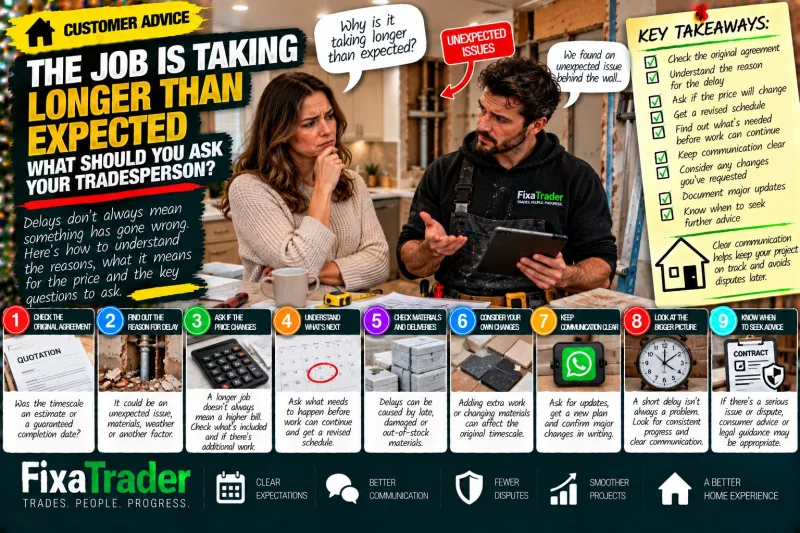
Not every job goes exactly according to plan.
A tradesperson might uncover damaged materials, unexpected structural problems or another issue that couldn't reasonably have been identified before work began.
A good quoting process should make clear how additional work or changes will be handled.
Ideally, significant changes should be discussed with the customer before additional costs are incurred.
That way, both sides know what has changed and why.9. Guarantees or Warranties
Where a guarantee or warranty applies, the quote or accompanying information should make this clear.
This might relate to the workmanship, a particular product or both.
The exact terms will vary significantly between trades and projects, so don't assume that every job comes with the same level of cover.
If a guarantee is important to you, ask what it covers and how long it lasts.10. The Business or Tradesperson You're Actually Hiring
Finally, make sure the quote clearly identifies who you're entering into an agreement with.
That might be an individual tradesperson, a sole trader, partnership or limited company.
The quotation should give you enough information to identify the professional or business providing the service and, where appropriate, their contact details.
This becomes particularly important if you're dealing with a larger project or contractor involving multiple people.Don't Compare Quotes by Price Alone
Once you've received multiple quotes, it's tempting to put them into a spreadsheet and immediately choose the lowest number.
But a quote is only useful for comparison if you're actually comparing like for like.
Consider two hypothetical quotes for a kitchen renovation.
Quote A — £12,000
Includes installation, standard units, worktops and flooring.
Quote B — £14,000
Includes installation, upgraded units, premium worktops, flooring, waste removal and additional electrical work.
At first glance, Quote A looks cheaper.
But they're not necessarily offering the same thing.
That's why understanding the detail behind the number matters.A Detailed Quote Doesn't Necessarily Mean a More Expensive Job
There's sometimes a misconception that a tradesperson providing a detailed quotation must be charging more.
That's not necessarily the case.
A detailed quote can actually make the process easier for everyone.
The customer knows what they're getting.
The tradesperson knows what they've agreed to deliver.
And if something changes, there's a reference point for discussing what was originally included.
For professionals, taking the time to explain a project properly can also demonstrate the level of organisation and communication customers increasingly expect.Don't Be Afraid to Ask Questions
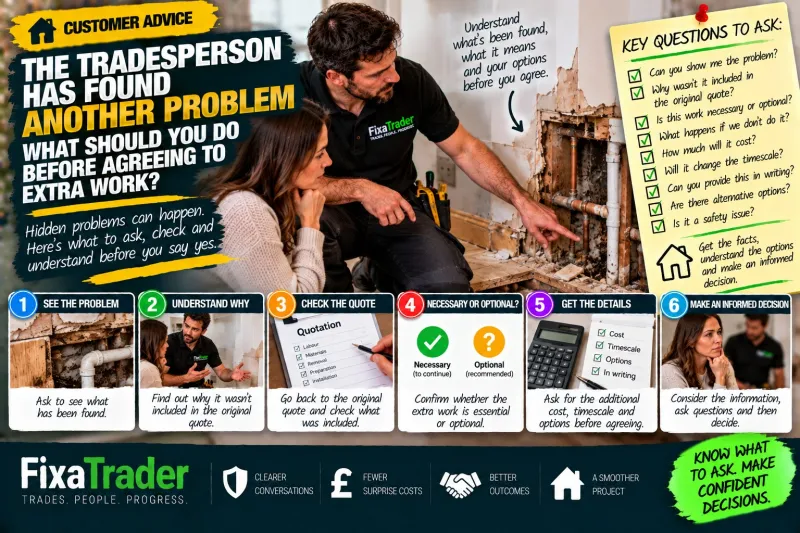
You don't need to understand every technical detail of a building project before accepting a quote.
But you should understand the important parts.
Before agreeing to the work, ask yourself:
Do I know exactly what is being done?
Do I know what I'm paying for?
Do I know what isn't included?
Do I understand the payment terms?
Do I have a reasonable idea of when the work will happen?
Do I know what happens if something changes?
If the answer to those questions is yes, you're in a much better position to make an informed decision.
The best quote isn't necessarily the cheapest one.
It's the one that gives you the clearest understanding of what you're getting, what you're paying and what you can expect from the professional you've chosen.
A little more detail before the work starts can prevent a lot of confusion later.
0 Comments
No comments yet — be the first to share your thoughts.