How to Compare Quotes From Tradespeople: 10 Things to Check Before Choosing
You've asked three tradespeople to price the same project. The quotations arrive: £4,800 £5,600 £6,350 At first glance, the decision looks simple. One tradesper...
You've asked three tradespeople to price the same project.
The quotations arrive:
£4,800
£5,600
£6,350
At first glance, the decision looks simple.
One tradesperson is £1,550 cheaper than another.
But then you start reading.
One includes waste removal.
Another doesn't.
One specifies the exact materials being supplied.
Another simply says “materials included.”
One includes making good afterwards.
Another expects you to arrange that separately.
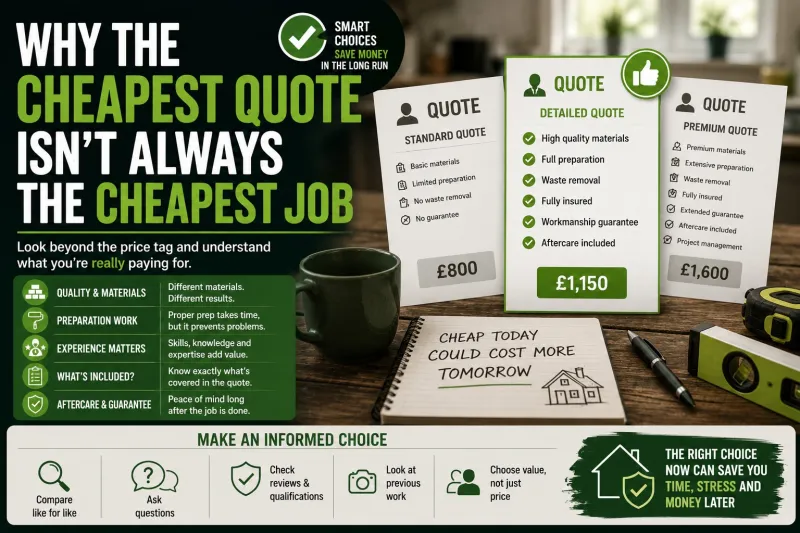
Suddenly, you don't have three different prices for exactly the same job.
You have three different versions of the job.
Before deciding which quotation offers the best value, here are ten things worth comparing.1. Start With the Scope of Work
Ignore the total price for a moment.
Read what each tradesperson is actually proposing to do.
If you're comparing quotations for a bathroom, for example, one might include removing the existing suite, preparing surfaces, installation and finishing.
Another may price only the installation because the customer is expected to arrange removal and preparation separately.
Both quotations could be perfectly legitimate.
They're simply not equivalent.
Ask yourself:
If I accepted this quotation exactly as written, what work would actually be completed?
That's the foundation for everything else.2. Look at What Isn't Included
Exclusions can be just as important as inclusions.
A quotation might specifically exclude:
Decoration.
Waste removal.
Scaffolding.
Parking charges.
Floor protection.
Making good.
Electrical work.
Specialist testing.
Or work discovered after existing surfaces are removed.
An exclusion isn't automatically a negative.
In fact, clearly stating what isn't included can be a sign that somebody has thought carefully about the scope.
The problem is discovering an exclusion only after you've assumed it was included.3. Compare the Materials and Specification
Two tradespeople can price the same basic job using very different products.
Imagine both quotations say:
Supply and install laminate flooring.
One has allowed for a basic product.
The other has specified a higher-grade floor, underlay, trims and preparation materials.
Those prices shouldn't be compared without considering the specification.
Look for:
Product names where relevant.
Brands or ranges.
Quantities.
Finish.
Performance specification.
And whether the customer or contractor is supplying particular items.
If a major material is vaguely described, ask what has actually been allowed for.4. Check Whether Preparation Is Included
Preparation is one of the easiest differences to overlook because much of it disappears underneath the finished work.
A beautifully painted wall may require considerable preparation beforehand.
New flooring depends on what's underneath it.
Tiling depends on the condition and suitability of the surface.
External finishes may require cleaning, repair or preparation.
One quotation may include substantial preparation.
Another may assume the existing surface is ready.
That difference can affect both the price and the finished result.
Don't compare only what you'll see when the project is finished.
Compare what needs to happen before the visible work begins.5. Check Who Is Responsible for Waste
Old materials have to go somewhere.
Depending on the job, that might include:
Old flooring.
Bathroom fittings.
Packaging.
Broken materials.
Timber.
Plasterboard.
Soil.
General construction waste.
One contractor may include appropriate removal and disposal in the quotation.
Another may expect the customer to arrange a skip or other suitable disposal.
Again, neither arrangement is necessarily wrong.
But waste removal has a cost, so make sure you're not comparing a price that includes it with one that doesn't.6. Look for Allowances Rather Than Fixed Selections
Some quotations contain allowances for items that haven't yet been chosen.
For example:
£600 allowance for tiles.
That doesn't necessarily mean the tiles will cost £600.
It means a figure has been included in the quotation based on that allowance.
If you later choose products costing £1,000, the project price may increase.
When comparing quotes, identify any provisional sums or allowances and ask what happens if the actual cost differs.
A £10,000 quotation containing several low allowances may not ultimately cost less than an £11,000 quotation based on the products you actually intend to buy.7. Compare How Unexpected Work Will Be Handled
Some projects contain more uncertainty than others.
If existing floors, walls or fittings need removing, nobody may know exactly what's underneath them beforehand.
Read what each quotation says about unforeseen work.
Will additional work be discussed before proceeding?
How will it be priced?
Are there specific assumptions behind the quotation?
A good quote doesn't need to predict every possible hidden problem.
But you should understand where the fixed scope ends and where a variation could begin.8. Look at the Payment Structure
Don't compare only the total.
Compare when you're expected to pay it.
One contractor might request a deposit followed by staged payments.
Another may require payment at different project milestones.
Smaller jobs may have much simpler arrangements.
The appropriate structure depends on the work, but you should understand:
The deposit.
When subsequent payments become due.
What those payments correspond to.
And when the final balance is payable.
A lower quotation isn't necessarily more attractive if you're uncomfortable with how the payment arrangement is structured.9. Compare the Business, Not Just the Document
The quote matters.
So does the person responsible for delivering it.
Before choosing, consider the wider evidence available.
Can you see examples of relevant work?
Are there genuine reviews?
Does the business have a professional presence?
Have they communicated clearly?
Are relevant registrations or qualifications required for parts of the work, and can these be checked?
Do their previous projects resemble the job you're asking them to complete?
A quotation tells you what somebody proposes to do.
Their professional track record can help you assess the evidence behind that proposal.10. Ask Questions Before Choosing
If one quotation is significantly different, you don't have to guess why.
Ask.
Suppose one quote is £2,000 cheaper.
You could say:
“I've received another quotation that appears to include some additional preparation. Can I check whether that's included in yours?”
That's much more useful than immediately assuming:
The expensive contractor is overcharging.
or:
The cheaper contractor must have missed something.
There may be a completely reasonable explanation.
Give the tradesperson an opportunity to clarify it.Don't Automatically Ask Everyone to Match the Cheapest Quote
Price matching makes sense when you're genuinely comparing identical products.
Trade work often isn't that simple.
If one contractor has included £800 worth of work that another has excluded, asking them to “match the cheaper quote” effectively means asking them to absorb the difference or remove something.
Instead, identify why the prices differ.
If you need to reduce the budget, ask whether the scope or specification can sensibly be adjusted.
That's a much clearer conversation.A More Detailed Quote Isn't Automatically the Better Quote
Detail is useful.
But don't choose somebody purely because their quotation is six pages long.
Likewise, don't automatically reject a capable tradesperson because their quote is concise.
The important question is whether the document gives you enough information to understand the agreement.
For a simple £150 repair, you probably don't need a document resembling a construction contract.
For a £40,000 renovation, a text saying “£40k all in mate” probably isn't enough.
The level of detail should make sense for the scale and complexity of the job.You're Comparing Certainty as Well as Price
A good quotation reduces ambiguity.
It helps answer:
What am I getting?
What am I supplying?
What could cost extra?
When will I pay?
What isn't included?
That clarity has value.
The cheapest quotation may still turn out to be the right choice.
The most expensive may be.
Or the middle one.
The purpose of comparing properly isn't to avoid choosing the lowest price.
It's to understand what each price actually buys you before you make the decision.
Don't start by asking which quote is cheapest. Start by asking whether all three quotes are actually pricing the same job.
0 Comments
No comments yet — be the first to share your thoughts.