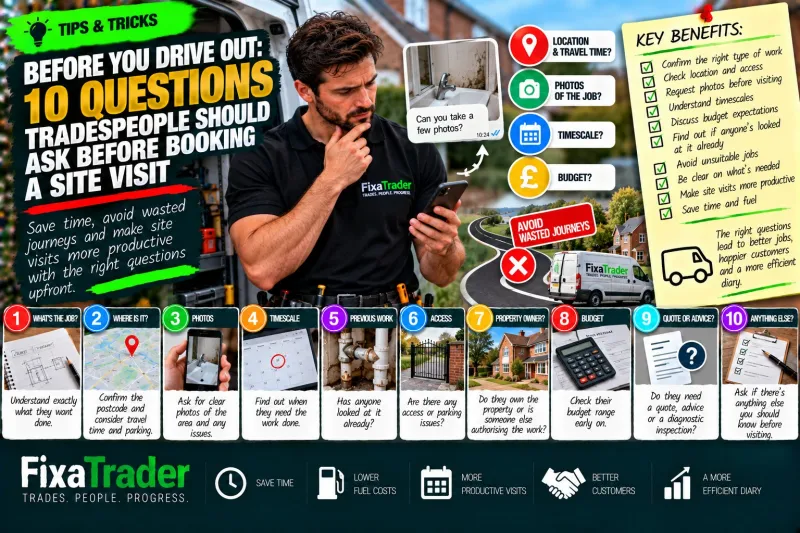
Before You Drive Out: 10 Questions Tradespeople Should Ask Before Booking a Site Visit
A customer calls about a job. It sounds promising. You arrange to visit Thursday evening. Thursday arrives. You finish your current job, drive 35 minutes across...
You finish your current job, drive 35 minutes across town, find somewhere to park and spend another 40 minutes discussing the work.
Then you discover something that could have been established during the original phone call.
The job isn't within your scope.
The customer needs it completed tomorrow.
Their budget bears no relation to the work involved.
They're actually looking for a different trade.
Or they're collecting six quotations for something they haven't decided whether they're doing.
Site visits are sometimes essential.
You need to inspect conditions, take measurements, understand access and see things photographs simply cannot show you.
But needing to see some jobs doesn't mean you need to see every enquiry.
A short qualification process before booking the visit can protect your time while also giving the customer a better experience.
Here are 10 questions worth asking.1. “What Are You Looking to Have Done?”
It sounds obvious, but don't settle for:
“I need some work doing in the bathroom.”
Find out what that actually means.
Are they replacing a tap?
Repairing a leak?
Installing a shower?
Refitting the entire bathroom?
Trying to diagnose damp?
The customer doesn't need to know the correct technical terminology.
Your job is simply to establish the approximate scope.
Useful follow-up questions might be:
What's happening at the moment?
What would you like to change?
Is this a repair or a new installation?
How much of the existing area are you planning to replace?
Five minutes here can prevent a completely unsuitable site visit.2. “Where Is the Job?”
Before putting anything in the diary, confirm the actual job location.
Not simply the customer's town.
Get enough information to understand where you're travelling.
A postcode is particularly useful.
You can then consider:
Travel time.
Parking.
Congestion.
Access.
Whether it's within your normal service area.
And how easily the visit fits around other work.
A job might technically be only eight miles away but take 50 minutes to reach at the time you've agreed to visit.
Distance and journey time aren't always the same thing.3. “Can You Send Me a Few Photos?”
Photos won't replace every inspection.
But they're one of the simplest ways to improve an enquiry before visiting.
Ask for useful photographs rather than:
“Send me a picture.”
Depending on the job, that might mean:
A wide photograph showing the whole area.
A closer photograph of the problem.
A photograph from another angle.
A picture showing access.
A photograph of an existing appliance, fitting or component.
A picture of any visible label or model information.
A customer may describe something as:
“A little crack beside the window.”
The photograph might immediately show that the situation is considerably different from what you imagined.
Equally, something that sounded complicated over the phone may become much easier to understand once you've seen it.4. “When Are You Hoping to Have the Work Done?”
This question can save both sides a lot of time.
Imagine your next meaningful availability is five weeks away.
The customer needs the work completed before a party next Saturday.
There's little value spending an evening conducting a site survey before discovering the timescales were incompatible from the beginning.
Ask early.
You might hear:
“As soon as possible.”
Clarify what that means.
For one customer it means tomorrow.
For another it means sometime within the next two months.
If you can't meet the required timeframe, say so before arranging the visit.5. “Has Anyone Looked at It Already?”
This question is particularly useful for repair and remedial work.
If another tradesperson has already attended, ask what happened.
Did they diagnose anything?
Was any work carried out?
Were parts replaced?
Did they provide a report or quotation?
Why isn't that person completing the work?
As we covered in our article on inherited work, previous intervention can significantly change what you're walking into.
It doesn't automatically make the job undesirable.
You simply want to know the history before arriving.6. “Is There Anything That Could Affect Access?”
A site visit is difficult if you can't actually inspect the site.
Depending on your trade, access issues could include:
Locked communal areas.
Tenants who need to be present.
Lofts with no practical access.
Furniture covering the area.
Restricted parking.
Permit-controlled roads.
Gated properties.
Commercial security procedures.
Working-hour restrictions.
Or another contractor occupying the space.
For future work, you may also need to know whether materials, equipment or a vehicle can reasonably reach the working area.
A ten-minute task can become a very different job when access is difficult.7. “Do You Own the Property, or Is Someone Else Authorising the Work?”
This doesn't need to become a legal interrogation.
You're trying to establish who can actually make decisions about the job.
The person contacting you might be:
The homeowner.
A tenant.
A landlord.
A letting agent.
A property manager.
A relative arranging work for somebody else.
Or an employee dealing with a commercial property.
That matters.
You don't want to spend an hour discussing options with someone only to discover that another person who wasn't present needs to approve everything.
Where appropriate, ask whether the decision-maker should attend the site visit or be included in the quotation process.8. “Have You Set a Budget for the Work?”
This question can feel awkward.
Some tradespeople avoid it because they worry the customer will think they're trying to discover the maximum they can charge.
So explain why you're asking.
For larger projects, budget helps establish whether the customer's expectations and proposed scope are broadly compatible.
You don't necessarily need an exact figure.
You might ask:
“Do you have a rough budget range you're trying to work within?”
Suppose someone wants a major transformation but has budgeted for a minor cosmetic update.
Discovering that before designing and pricing the entire job gives you an opportunity to discuss alternatives.
Budget isn't always about rejecting customers.
Sometimes it helps you propose a more realistic scope.9. “Are You Looking for a Quote, Advice or an Inspection?”
These are not necessarily the same service.
Some enquiries sound like quotation requests but are really requests for professional diagnosis.
For example:
“Can you come round and tell me what's wrong, what needs doing and then I'll decide?”
That may involve substantial expertise and investigation before any actual repair is undertaken.
Depending on your trade and business model, diagnostic visits may be chargeable.
If so, explain that before the appointment.
Similarly, someone planning a large project may initially need consultation rather than a final fixed quotation.
Understanding what the customer expects from the visit prevents awkward conversations afterwards.10. “Is There Anything Else I Should Know Before I Come?”
Finish with an open question.
It catches things your checklist didn't.
The customer might suddenly say:
“Actually, the ceiling started leaking again yesterday.”
Or:
“The electricity is currently switched off.”
Or:
“We're halfway through removing the kitchen.”
Or:
“The previous builder said there might be asbestos.”
That final piece of information can completely change how you approach the enquiry.
Give customers an opportunity to tell you what they think might be relevant.Not Every Question Needs to Be Asked Every Time
Don't turn your enquiry process into a call centre script.
Someone asking:
“Can you replace this broken internal door handle?”
probably doesn't need to answer ten questions.
A customer planning a £30,000 renovation might.
The amount of qualification should be proportionate to the job.
For smaller enquiries, you may only need:
What needs doing?
Where are you?
Can you send a photo?
When do you need it?
For larger or uncertain work, dig deeper.
The objective is useful information, not bureaucracy.Create a Repeatable Enquiry Checklist
If you regularly forget to ask important questions, create a simple checklist.
It might include:
Name
Phone/email
Job postcode
Type of work
Description
Photos received
Desired timescale
Access notes
Previous work
Budget where relevant
Site visit required?
This could live in:
Your phone notes.
A spreadsheet.
Your CRM.
Your booking system.
Or whatever system you already use to manage enquiries.
The technology matters less than consistency.Use Photos to Decide Whether a Visit Is Necessary
Sometimes the result of your initial questions will be:
Yes, I definitely need to see this.
Good.
That's a productive site visit.
Other times, photographs and information may allow you to establish that:
The job isn't suitable.
You don't provide that service.
The customer needs another trade first.
You're unavailable within their timeframe.
Or you can provide enough initial guidance without immediately travelling there.
Every unnecessary journey removed from the diary creates space for something else.But Don't Try to Quote Everything From Photographs
There's an opposite mistake.
Once tradespeople become good at qualifying remotely, it can become tempting to price everything from WhatsApp pictures.
Photographs have limits.
They may not show:
Hidden damage.
Dimensions accurately.
Access difficulties.
The condition behind a surface.
The full extent of previous work.
Services within the area.
Or complications the customer doesn't recognise as relevant.
If you need to inspect before giving a reliable quotation, inspect.
Remote qualification is supposed to help determine whether a site visit is worthwhile, not eliminate proper surveys.Group Site Visits Geographically Where You Can
If you know where every enquiry is located, you can plan visits more efficiently.
Instead of:
Monday — north side of town.
Tuesday — south side.
Wednesday — north side again.
You may be able to arrange several nearby visits together.
This won't always work because customers have their own availability.
But even modest route planning can reduce:
Fuel.
Mileage.
Driving time.
And dead gaps between appointments.
Your service area becomes much more efficient when the diary reflects geography.Give the Customer an Appointment Window You Can Realistically Keep
A site visit is also the customer's first experience of working with you.
If you say:
“I'll be there at exactly 4:00pm.”
while spending the entire day on unpredictable jobs, you're creating a promise you may struggle to keep.
Where appropriate, use a realistic arrival window.
For example:
“I'll aim to arrive between 4:00 and 4:30. If the previous job delays me, I'll let you know.”
Then actually communicate if you're running late.
Customers are often far more understanding about delays when they aren't left wondering whether you're coming at all.Confirm the Visit
A quick confirmation can prevent wasted journeys.
Depending on how your business operates, that could be:
The day before.
The morning of the visit.
Or when you're preparing to travel.
Something as simple as:
“Just confirming we're still okay for the site visit at approximately 4pm today.”
can catch forgotten appointments before you've driven across town.
For particularly long journeys, confirmation becomes even more valuable.Keep Notes During the Visit
Qualification shouldn't stop when you arrive.
Record enough information to produce an accurate quotation later.
Depending on the job:
Take measurements.
Take photographs with permission where appropriate.
Record product choices.
Note access.
Clarify who supplies what.
Record exclusions.
Discuss timescales.
Identify decisions still outstanding.
If you leave relying entirely on memory, the details of three different quotations can quickly merge together.Decide What Happens Next Before You Leave
The customer shouldn't be wondering:
“So... what happens now?”
Before leaving, explain the next step.
For example:
“I'll send the written quotation by Friday.”
Or:
“I need to check availability and price for that component first, then I'll come back to you.”
Or:
“This needs another specialist to investigate that issue before I can price my part properly.”
Clear next steps make the entire process feel more professional.
They also reduce unnecessary:
“Any update on the quote?”
messages.Track Which Site Visits Actually Become Work
This is where the process becomes useful business information.
Suppose you conduct:
20 site visits.
You send:
18 quotations.
And win:
3 jobs.
That doesn't automatically mean your prices are too high.
Look deeper.
Where did those enquiries come from?
What kinds of jobs were they?
Were they within your normal service area?
How much time did the visits and quotations consume?
Were customers genuinely ready to proceed?
Now compare that with another enquiry source where one in every three visits becomes a job.
You may discover that some enquiries are far more valuable than others.
Over time, your qualification process can improve based on evidence rather than instinct alone.Charging for Site Visits Isn't Automatically Wrong
Whether to offer free quotations or charge for visits depends heavily on the trade and type of work.
A straightforward quotation for a clearly defined project may reasonably be free.
A visit involving:
Fault finding.
Testing.
Professional diagnosis.
Detailed specification.
Surveying.
Or substantial advisory work
may be different.
The important thing is clarity.
If there's a charge, tell the customer before the appointment and explain what they're receiving for it.
Don't reveal a diagnostic fee after you've arrived.Don't Qualify So Aggressively That Good Customers Feel Unwelcome
Efficiency can go too far.
A homeowner shouldn't feel as though they're applying for permission to hire you.
Keep the conversation natural.
You're gathering enough information to help them properly.
A useful mindset is:
“What do I need to know to decide the best next step for this customer?”
Sometimes the answer is a site visit.
Sometimes it's requesting photographs.
Sometimes it's recommending another trade.
Sometimes it's telling them you can't meet their timeframe.
Good qualification isn't about finding reasons to reject work.
It's about directing enquiries appropriately.A 5-Minute Enquiry Can Save a 2-Hour Journey
Consider the real cost of an unnecessary site visit.
Thirty minutes travelling there.
Forty-five minutes at the property.
Thirty minutes travelling back.
Then another thirty minutes preparing a quotation.
That's nearly two hours.
Do that three times in a week and you've lost most of a working day.
A few sensible questions won't eliminate every wasted visit.
They shouldn't.
Some jobs only reveal their complexity once you're standing in front of them.
But if one five-minute conversation tells you that a site visit isn't necessary, that's time you can spend:
Completing paid work.
Preparing worthwhile quotations.
Following up customers.
Managing the business.
Or simply finishing the day earlier.
The aim isn't to avoid site visits. It's to make sure that when you get in the van, you already know enough about the customer, the job and the opportunity to make the journey worthwhile.
0 Comments
No comments yet — be the first to share your thoughts.