Why More Electricians Are Choosing WAGO Connectors for Modern Installations
Walk into a modern electrical installation and there's a good chance you'll encounter a component that has become increasingly familiar to electricians over the...
Walk into a modern electrical installation and there's a good chance you'll encounter a component that has become increasingly familiar to electricians over the last decade: the WAGO connector.
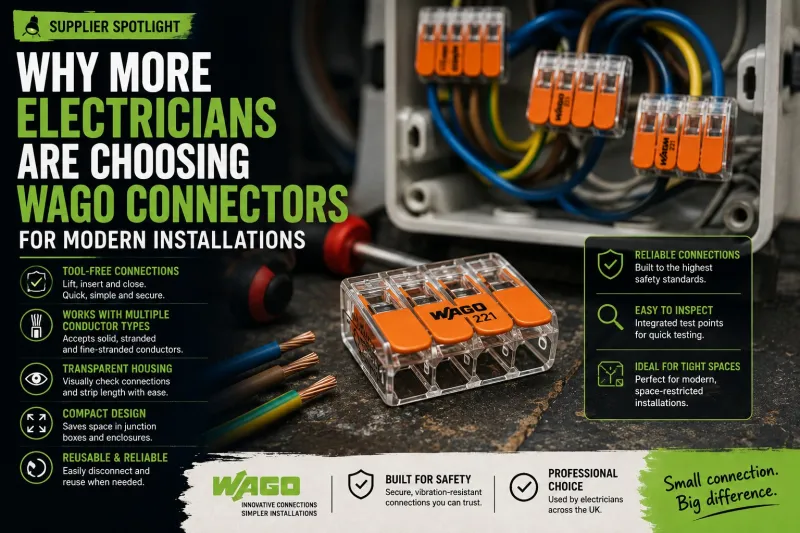
The distinctive lever-operated connectors have become particularly common in domestic and commercial electrical work, with the 221 series designed to connect solid, stranded and fine-stranded conductors without requiring a traditional screw terminal.
But popularity alone doesn't make a product the right choice for every installation.
So why have WAGO connectors become so widely used, and what are the practical advantages that make them appealing to electricians?The Appeal Is Simplicity
The basic concept behind the WAGO 221 is remarkably straightforward.
Lift the lever, insert the conductor and close the lever.
That's it.
The lever-operated design provides a tool-free method of making and disconnecting connections, which can be particularly useful when working in confined spaces or when connections need to be inspected or altered during an installation.
For an electrician working through dozens of connections, reducing the amount of fiddly work involved can make a noticeable difference.
It's not necessarily about dramatically changing how an installation works. It's about making individual tasks easier and more repeatable.One Connector Can Handle Different Conductor Types
One of the more useful characteristics of the 221 series is its ability to accommodate different conductor types.
WAGO's GB documentation states that its 221 connectors can accommodate solid, stranded and fine-stranded conductors, with the relevant models covering different conductor sizes.
That flexibility is useful in situations where an installation contains different types of conductor.
Instead of relying on a connector designed around a single conductor type, electricians can use a compatible 221 model where the relevant specifications allow it.
Of course, that doesn't mean every WAGO connector is suitable for every situation. The specific connector, conductor size, installation method and electrical requirements still need to be checked before installation.The Transparent Housing Is More Useful Than It Looks
One of the less glamorous but genuinely practical features is the transparent housing.
It allows the installer to visually check whether the conductor has been inserted correctly and stripped to the appropriate length. WAGO also incorporates test points into the 221 design, allowing standard test probes to be used.
That visibility can be particularly valuable during inspection and fault finding.
Rather than relying entirely on whether a connection looks correctly assembled from the outside, there's an additional visual indication of what's happening inside the connector.
For professionals who regularly have to diagnose installations later, that kind of accessibility can be useful.Space Matters
Modern electrical installations don't always give electricians generous amounts of room.
Distribution boxes, junction boxes and other enclosures can become crowded surprisingly quickly.
The compact dimensions of the 221 series are one reason WAGO positions it for space-restricted applications. The company says the 221 can save significant space compared with its earlier 222 series.
That doesn't mean every connection should automatically be replaced with a compact connector.
But when you're trying to keep an installation organised inside a limited enclosure, the physical size of connection components can make a difference.They're Also Reusable
Another practical advantage of lever connectors is that connections can be disconnected without destroying the connector.
That's useful when modifications or fault finding are required.
An electrician may need to temporarily disconnect a conductor, replace a component or alter part of an installation.
With a lever-operated connector, that process doesn't necessarily involve cutting away a connector and replacing it simply to access the conductor.
Again, the specific connector and application need to be appropriate, but the principle is useful.But WAGO Isn't Automatically the Answer
This is where the discussion around WAGO connectors becomes more interesting.
A product becoming popular doesn't mean it should be used everywhere.
Electrical connections still need to comply with the requirements applicable to the installation. The connector's specifications, conductor size, current rating, enclosure, environment and method of installation all matter.
WAGO's product range itself illustrates this point.
The company offers different versions for different conductor sizes, applications and environments, including dedicated products for certain hazardous-area applications.
So the important question isn't:
“Can I use a WAGO here?”
It's:
“Is this particular connector appropriate for this particular installation?”
That's the approach experienced electricians take with any component.Why They're Becoming Part of the Modern Electrician's Toolkit
The real reason WAGO connectors have become so popular isn't one individual feature.
It's the combination.
Tool-free operation.
Visual inspection.
Compatibility with multiple conductor types.
Compact dimensions.
Straightforward disconnection.
And a design that fits naturally into modern installation work.
Those advantages can add up over hundreds of connections and countless jobs.
For an electrician, anything that makes repetitive installation work cleaner, quicker or easier to inspect is naturally going to attract attention.The Bigger Picture
WAGO isn't the only manufacturer producing modern connection technology, and traditional connection methods still have their place.
The interesting development is the broader shift towards components that make installations easier to assemble, inspect, maintain and modify.
That's something electricians are likely to see more of as electrical installations become increasingly complex.
From smart-home equipment and EV charging to solar installations, battery storage and increasingly technology-heavy buildings, the demands placed on electrical systems continue to change.
The humble connector might not be the most exciting part of that transformation.
But sometimes the smallest components have a surprisingly large impact on how professionals do their jobs.
For electricians, that's ultimately what makes products like the WAGO 221 worth paying attention to—not because they're fashionable, but because good connection technology can make everyday installation work simpler, cleaner and more practical.
Product specifications and suitability can vary between models. Always check the manufacturer's technical documentation and the requirements applicable to the specific installation before using any electrical connection product.
0 Comments
No comments yet — be the first to share your thoughts.