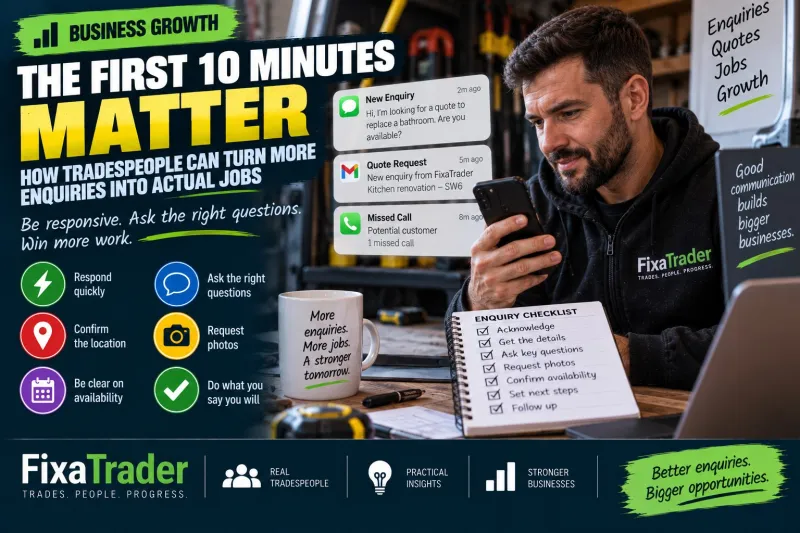
The First 10 Minutes Matter: How Tradespeople Can Turn More Enquiries Into Actual Jobs
A customer needs a tradesperson. They search online, ask for recommendations or find a business whose work looks promising. Then they make contact. Maybe they c...
They search online, ask for recommendations or find a business whose work looks promising.
Then they make contact.
Maybe they call.
Send a message.
Submit an enquiry.
Or request a quote.
For the customer, this might be the first time they've ever interacted with your business.
And what happens next can have a surprisingly large influence on whether you eventually win the job.
You can be excellent at your trade.
You can have years of experience.
You can produce brilliant work.
But the customer doesn't know any of that yet.
At the beginning, they're judging something much simpler:
What is this business going to be like to deal with?Customers Aren't Only Comparing Prices
It's easy to assume that every homeowner contacting several tradespeople is simply looking for the cheapest quote.
Some undoubtedly are.
But many are also trying to answer questions such as:
Will they actually turn up?
Do they understand what I need?
Can I trust them in my home?
Will they communicate properly?
Do they seem organised?
How quickly could they do the work?
Your first interaction starts answering those questions before you've discussed a price.1. Acknowledge the Enquiry
You can't always answer immediately.
If you're underneath a sink, halfway up a ladder or operating machinery, you obviously shouldn't stop working just because your phone rings.
But there is a difference between not answering immediately and allowing an enquiry to disappear for several days.
Even a short acknowledgement can reassure someone that their message has reached you.
Something as simple as:
“Thanks for getting in touch. I'm on a job at the moment, but I'll have a proper look at this later today and come back to you.”
Now the customer knows what is happening.
Without that acknowledgement, they may simply move on to the next business.2. Don't Try to Run Your Business From Memory
A customer calls while you're working.
You remember their first name.
You vaguely remember something about a leaking shower.
You tell yourself you'll call them tonight.
Three more customers contact you.
A supplier calls.
The job you're working on runs late.
By 7pm, you've forgotten who needed what.
This is how perfectly good enquiries disappear.
You don't necessarily need complicated software.
You just need a system.
Record:
Customer name
Contact details
Location
Type of work
When they contacted you
What happens next
When you promised to respond
The important part is getting the enquiry out of your head and into somewhere reliable.3. Ask the Right Questions Early
Not every enquiry requires an immediate site visit.
A few useful questions can tell you whether the job is suitable before either side spends unnecessary time.
Depending on your trade, you might ask:
Where is the property?
What exactly is happening?
When did the problem start?
What work are you hoping to have done?
Can you send some photos?
Is there access to the area?
Is the job urgent?
Have you had any previous work carried out there?
Good questions aren't about interrogating the customer.
They're about understanding the job.4. Photos Can Save Everyone Time
For many types of work, a few photographs can immediately provide useful context.
A decorator may want to see the condition of a wall.
A roofer may want photographs showing where water is appearing internally.
A flooring installer may want to see the existing floor.
A landscaper may want an overview of the garden and access.
Photos won't always replace an inspection.
And customers shouldn't be expected to diagnose the problem themselves.
But visual information can help you decide what the next step should be.5. Establish the Location Before Getting Too Far
This sounds obvious.
Yet it's easy to spend ten minutes discussing a job before discovering that it's well outside your normal working area.
Ask for the postcode early.
If you don't cover the area, say so.
If you'll travel there for larger jobs but not smaller ones, establish whether the enquiry is likely to fit.
A clear service area saves wasted conversations and unnecessary journeys.6. Qualify the Job Without Making the Customer Feel Unwanted
Tradespeople need to qualify enquiries.
There is nothing wrong with that.
You need to know whether the job suits:
Your skills.
Your location.
Your availability.
Your typical project size.
Your business.
But tone matters.
Compare:
“Too small. Not interested.”
with:
“Thanks for thinking of us. We mainly take on larger renovation projects, so we're probably not the right fit for this particular repair.”
Both decline the job.
Only one leaves a professional impression.
And that customer may have a much larger project next year.7. Be Clear About Availability
Customers frequently ask:
“When can you do it?”
If you're booked for six weeks, don't imply that you might somehow squeeze them in next Tuesday just to keep the enquiry alive.
Tell them.
Likewise, if you've had a cancellation and can visit tomorrow, that's useful information.
Availability itself isn't necessarily good or bad.
Uncertainty is often the bigger problem.
A customer who knows you're available in three weeks can decide whether that works for them.
A customer who repeatedly hears “I'll let you know” has nothing to make a decision with.8. Don't Give False Precision From Incomplete Information
Customers naturally want to know what something will cost.
Sometimes you can provide a meaningful indication remotely.
Sometimes you can't.
If you haven't seen enough information to price accurately, don't invent certainty simply because the customer wants a number.
You might explain:
“I can give you a rough indication from the photos, but I'd need to inspect it before confirming the price.”
That is more useful than quoting a figure you later have to substantially change.
Professionalism includes knowing when you don't yet know enough.9. Explain What Happens Next
One of the simplest improvements a business can make is telling customers what the next step is.
For example:
“Send me those photos and the postcode this evening. I'll review them tomorrow morning and let you know whether I need to visit.”
Or:
“I'll come out Thursday at 4pm, take a look and send the written quotation by Monday.”
Now both parties understand the process.
Without that clarity, the customer may wonder whether they're supposed to call you again.10. Do What You Said You Would Do
This might be the most important point in the entire article.
If you say:
“I'll call tonight.”
Call tonight.
If you say:
“I'll send the quote Friday.”
Send it Friday.
If something changes, communicate.
Customers don't expect every project to run perfectly.
Jobs overrun.
Suppliers delay deliveries.
Emergencies happen.
But repeatedly failing to do what you've said creates doubt.
And once someone begins wondering whether they can rely on you before the job has even started, winning their confidence becomes much harder.Your Profile Has Already Started the Conversation
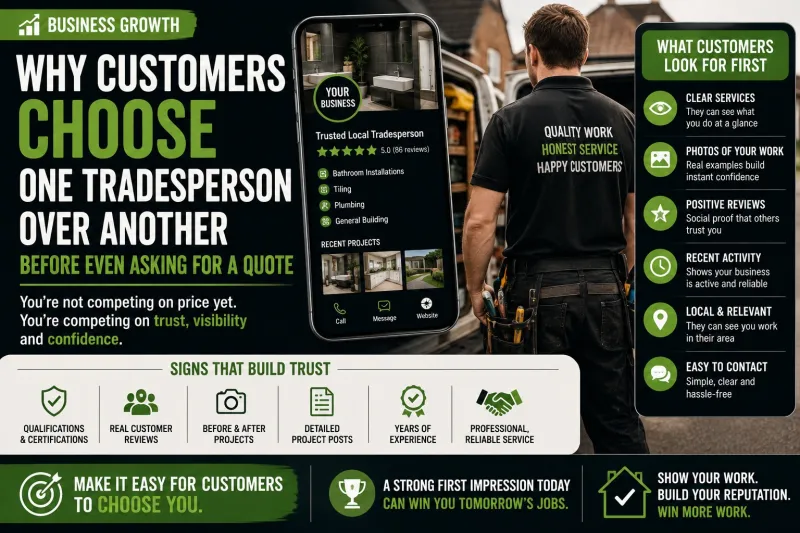
Before contacting you, a potential customer may already have looked at your business online.
They may have seen:
Your completed work.
Reviews.
Services.
Location.
Qualifications.
Business information.
Photographs.
Years of experience.
That information can do some of the trust-building before you ever speak.
It's one reason maintaining a professional business presence matters.
Your first message isn't necessarily the customer's first impression of you.Not Every Enquiry Should Become a Quote
This is important.
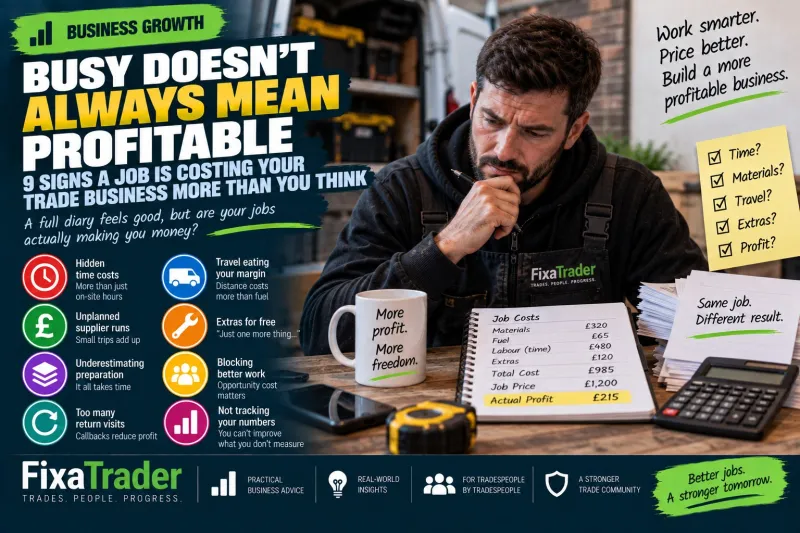
A high number of enquiries doesn't automatically mean you should quote every one.
Some jobs will be:
Outside your area.
Outside your expertise.
Too small.
Too large.
Needed sooner than you can provide.
Poorly suited to your business.
Or simply not something you want to take on.
Qualifying enquiries properly means spending more of your quoting time on jobs you actually have a realistic chance of winning and completing successfully.Track Where Your Good Enquiries Come From
Ask yourself:
Where are your best customers finding you?
Recommendations?
Google?
Your website?
A professional profile?
Social media?
Previous customers?
Local groups?
A directory?
Different sources can produce very different types of enquiries.
Twenty enquiries that never fit your business may be less valuable than five that regularly turn into profitable jobs.
Don't only count leads.
Track useful enquiries and completed work.Speed Matters But You Don't Need to Be Available 24/7
There's a temptation to think good customer service means responding instantly at all hours.
It doesn't.
Tradespeople need time away from work too.
The solution is creating expectations.
If you generally respond to new enquiries between 5pm and 7pm, that's fine.
If you don't answer business messages on Sundays, that's fine too.
What matters is making the process manageable and consistent.
Otherwise the business owner becomes permanently attached to their phone.Create a Simple Enquiry Routine
A straightforward routine might look like this:
New enquiry arrives
↓
Acknowledge it
↓
Record the customer's details
↓
Ask the key qualifying questions
↓
Request useful photos/information
↓
Decide whether the job fits
↓
Arrange a visit or provide the appropriate next step
↓
Record when you need to follow up
It doesn't need to be complicated.
Consistency is more valuable than complexity.Templates Can Help You Without Sounding Like a Robot
If you repeatedly type the same questions, save them.
For example:
“Thanks for getting in touch. Could you send over the property postcode, a couple of photos and a brief description of what you'd like done? Once I've had a look, I'll let you know the best next step.”
That's efficient.
Then personalise the conversation once you have the information.
Templates should remove repetitive admin.
They shouldn't make every customer feel as though they're talking to an automated system.The Enquiry Experience Becomes Part of Your Reputation
A customer might contact you and never hire you.
That doesn't mean the interaction has no value.
Perhaps you were fully booked.
Perhaps the job wasn't suitable.
Perhaps they chose somebody else.
But if you were helpful, clear and professional, they may remember you.
They may contact you later.
They may recommend you.
They may come back with a different project.
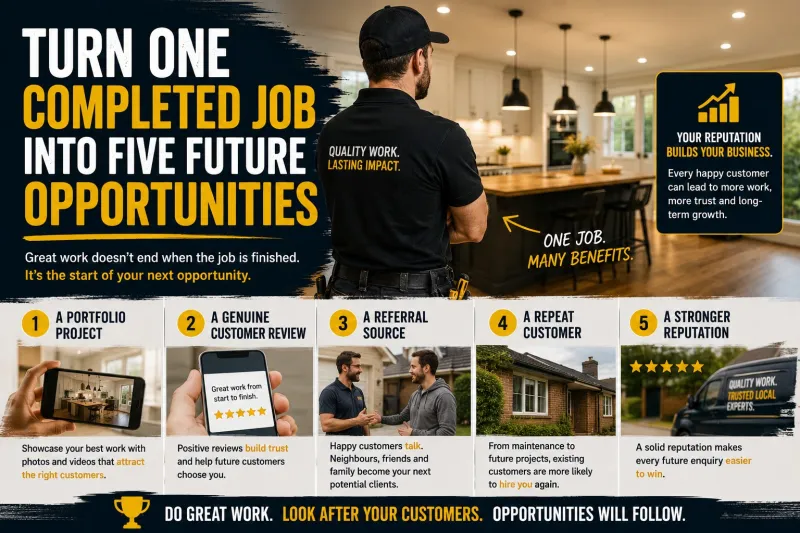
Reputation isn't built exclusively on completed jobs.
It's also built through all the smaller interactions surrounding them.You Don't Need to Win Every Enquiry
The objective isn't:
Turn every message into a paying customer.
That's neither realistic nor desirable.
The objective is to make sure good opportunities aren't being lost because of avoidable things such as:
Forgotten messages.
Unclear communication.
Missing information.
Slow follow-ups.
Broken promises.
Or no obvious next step.
You may already be receiving enough enquiries.
The opportunity could simply be handling the ones you have more effectively.
The first ten minutes won't win every job but they can decide whether you ever get the opportunity to quote for it.
0 Comments
No comments yet — be the first to share your thoughts.