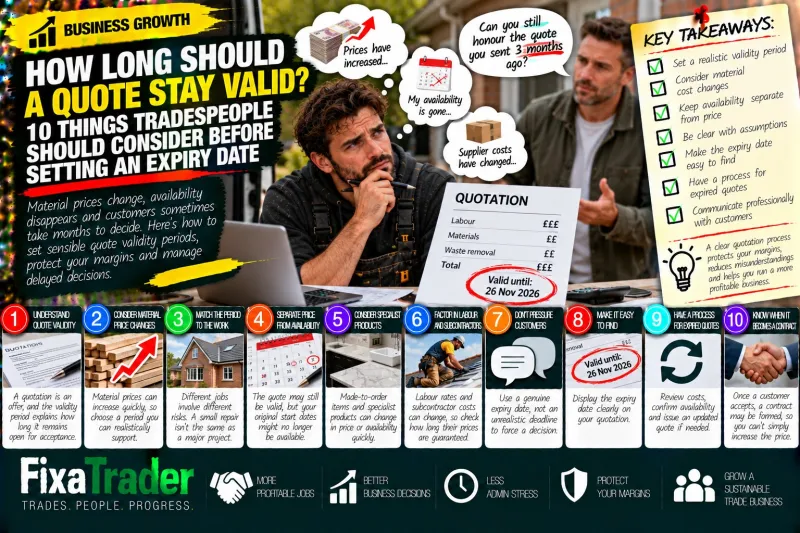
How Long Should a Quote Stay Valid? 10 Things Tradespeople Should Consider Before Setting an Expiry Date
You visit a customer's property, assess the work and prepare a quotation. They thank you and say they'll be in touch. A week passes. Then a month. Eventually, y...
You visit a customer's property, assess the work and prepare a quotation.
They thank you and say they'll be in touch.
A week passes.
Then a month.
Eventually, you forget about the enquiry.
Three months later, your phone rings.
"Hi, we'd like to go ahead with that quote you sent us."
The problem?
Your supplier has increased its prices, your labour costs have changed and the dates you originally had available are long gone.
The customer, meanwhile, expects everything to proceed exactly as originally discussed.
It's a familiar situation for many tradespeople.
And it highlights an important question that doesn't always receive enough attention.How long should your quotations actually remain valid?
There's no single validity period that works for every trade or project.
A straightforward repair and a major renovation involve very different risks.
But setting clear expectations can help protect your margins, reduce misunderstandings and make your business easier to manage.
Here are ten things worth considering.1. Understand What Quote Validity Actually Means
A quotation is generally an offer to complete specified work for a stated price, subject to the terms and conditions attached to it.
A validity period explains how long that offer remains open for acceptance.
For example, a quotation might state:
"This quotation is valid for 30 calendar days from the date of issue."
That gives the customer a defined period in which to decide whether to accept.
It also gives your business a clearer point after which the original offer is no longer available for acceptance.
However, the legal effect depends on the wording, circumstances and whether a contract has already been formed.
An expiry date is not automatically permission to change the price of work the customer has already accepted.
Once a binding agreement exists, different contractual considerations apply.
The aim is to establish clarity before the customer commits, not create an opportunity to change agreed prices arbitrarily.2. Consider How Quickly Your Material Costs Can Change
Material prices are one of the main reasons tradespeople need to think carefully about quote validity.
Some materials have relatively stable pricing.
Others may fluctuate because of supplier increases, availability, transport costs or wider market conditions.
A quotation prepared using today's supplier prices may no longer be profitable several months later.
This is particularly relevant for projects involving substantial material purchases.
Examples might include:
Roofing materials.
Timber and sheet materials.
Electrical equipment.
Heating systems.
Specialist fixtures and fittings.
Made-to-order products.
Before setting an expiry date, consider whether your supplier has guaranteed its prices and for how long.
If a supplier's price is only confirmed for a short period, promising the customer a much longer fixed-price window may expose your business to unnecessary risk.3. Match the Validity Period to the Type of Work
Not every quotation needs the same expiry date.
A relatively straightforward service may involve predictable labour and material costs.
A larger project may require several suppliers, subcontractors and specialist products.
The uncertainty is different.
Some businesses use a standard validity period of 14 or 30 days.
Others choose longer periods where pricing is stable.
These are business choices rather than universal legal requirements.
The important thing is to select a period you can realistically support.
For example, a small repair using readily available materials may justify a different approach from a kitchen installation involving products with changing lead times.
Your validity period should reflect the risks associated with the job, not simply a number copied from another business.4. Separate Price Validity From Availability
This is one of the most important distinctions to make.
A quotation may remain valid for 30 days.
But that doesn't necessarily mean the dates discussed during the initial enquiry remain available throughout that period.
Imagine you tell a customer you currently have availability in three weeks.
They take 25 days to accept the quotation.
By then, you've booked other work.
The price might still be valid, but the original start date may no longer be realistic.
Consider stating clearly that scheduling is subject to confirmation when the booking is accepted.
For example:
"The quoted price is valid until the date shown. Proposed start dates are indicative and subject to availability at the time of booking."
This helps prevent customers from assuming that an informal discussion about dates amounts to a guaranteed reservation.5. Be Careful With Specialist and Made-to-Order Products
Some projects depend on products that cannot be purchased immediately or returned easily.
Examples include bespoke glazing, made-to-measure joinery, specialist worktops and custom-manufactured components.
These products can involve:
Supplier lead times.
Deposit requirements.
Limited availability.
Manufacturing changes.
Product discontinuation.
Restrictions on cancellation or returns.
A long quotation validity period may be difficult to support where product prices or specifications are not guaranteed.
If the customer wants time to consider their options, explain that the quotation may need to be reconfirmed before an order is placed.
Once the customer accepts and a contract is formed, make sure any subsequent purchasing and cancellation arrangements comply with applicable consumer law.
Don't assume that a supplier's non-refundable terms automatically determine what you can charge a consumer.6. Account for Labour and Subcontractor Costs
Materials aren't the only costs that can change.
Your own labour rates may increase.
Subcontractors may revise their prices.
Fuel, insurance and other operating expenses can also affect the cost of delivering a job.
For projects that require several people or specialist contractors, your quotation may depend on prices obtained from others.
Ask how long those prices remain available.
If a subcontractor's figure is subject to reconfirmation, that uncertainty should inform your own quotation process.
You don't necessarily need to explain every internal cost to the customer.
But you should avoid making promises that depend on third-party prices you cannot control.7. Don't Use Short Expiry Dates Simply to Pressure Customers
A quotation expiry date should have a genuine commercial purpose.
It may reflect material pricing, scheduling or other legitimate uncertainties.
But deliberately using an unrealistically short deadline to pressure customers can damage trust.
For example, telling a homeowner that a price disappears tomorrow when there's no genuine reason for urgency may create unnecessary suspicion.
Customers often need time to compare quotations, discuss the project with family members or arrange finance.
A professional approach explains the validity period without turning it into a sales tactic.
You might say:
"I've kept this quotation valid for 30 days because supplier pricing can change. If you need longer, just let me know and I can check whether the figures still stand."
That gives the customer useful information without applying unreasonable pressure.8. Make the Expiry Date Easy to Find
A validity period is less useful if the customer never notices it.
Avoid hiding important conditions in lengthy documents where they are unlikely to be understood.
Instead, include the information clearly within the quotation.
For example:
Quotation issued: 26 October 2026
Valid until: 25 November 2026
Start date: To be confirmed upon booking
You can also include a brief explanation of what happens after the validity period expires.
For example:
"If accepted after this date, the quotation will need to be reviewed and reissued before work can be booked."
Make sure your wording is consistent across the quotation, accompanying messages and any applicable terms.
Clear presentation can prevent a surprising number of misunderstandings.9. Have a Process for Expired Quotations
What happens when a customer accepts a quotation after its expiry date?
Your business should have a consistent approach.
You might review the original figures, check supplier prices and confirm your availability.
If nothing has changed, you may decide to issue a fresh quotation at the same price.
If costs have increased, explain the changes and provide a revised offer.
The important thing is to avoid treating an expired quotation as automatically accepted at its original price.
For example:
"Thanks for getting back to me. The original quotation has now expired, so I'll check current material costs and availability before confirming the updated price."
This keeps the conversation professional.
It also gives the customer an opportunity to decide whether to proceed under the revised terms.10. Know When a Quote Has Become a Contract
This is where careful wording matters most.
A quotation isn't always just an informal indication of price.
Depending on the circumstances, it may amount to an offer capable of acceptance.
If a customer accepts it within the applicable period, a binding contract may be formed.
That can happen before work starts or a deposit is paid.
Equally, the precise position may depend on conditions in the quotation, the parties' communications and whether acceptance was valid.
Once a contract exists, you generally cannot simply impose a higher price because your costs have increased.
Any contractual price adjustment provisions must be lawful and fair, particularly when dealing with consumers.
If you're uncertain about the legal effect of your quotation terms, obtain appropriate professional advice.
A clear expiry date helps manage offers. It doesn't replace a properly drafted contract.Is 14, 30 or 60 Days the Best Validity Period?
There's no universally correct answer.
Each period has potential advantages and disadvantages.
14 days
A shorter period may be appropriate where supplier prices are particularly uncertain or products have limited availability.
However, it may be impractical for customers planning larger projects.
30 days
A month can offer a reasonable decision-making window for many types of work while limiting the period during which the business is exposed to changing costs.
But it still needs to reflect the actual circumstances.
60 days or longer
Longer periods may suit predictable services or projects where prices can be supported for an extended time.
They can also give customers more flexibility.
However, they increase the importance of checking supplier commitments and other cost assumptions.
The best validity period is the one your business can confidently honour if the customer accepts on the final day.What If the Customer Wants You to Hold the Price for Six Months?
Some customers plan projects well in advance.
They may want a quotation now but intend to start work much later.
That doesn't automatically make them unsuitable customers.
But it changes how the quotation should be managed.
One approach is to provide a preliminary estimate for budgeting purposes and explain that a confirmed quotation will be prepared closer to the intended start date.
For example:
"I can give you an indication of the likely cost now, but because the project isn't planned until next spring, I'd need to confirm material prices and availability nearer the time."
This allows the customer to plan without requiring you to guarantee costs that may change.
For larger projects, it may be appropriate to separate the initial budgeting stage from detailed specification and contractual pricing.Should You Follow Up Before a Quote Expires?
Yes, provided the follow-up is appropriate and the customer hasn't asked you to stop contacting them.
A polite reminder can help customers who are interested but haven't made a decision.
It doesn't need to be complicated.
For example:
"Hi, just checking whether you had any questions about the quotation I sent over. It's currently valid until Friday, so let me know if you'd like to discuss anything before then."
The purpose is to offer assistance and clarify the deadline.
Avoid creating false urgency or repeatedly chasing someone who isn't interested.
A single well-timed follow-up may be more effective than several messages that make the customer feel pressured.What If the Customer Accepts Just Before the Deadline?
Suppose a customer accepts on the final day of the validity period.
You discover that material prices have increased since you issued the quotation.
This is exactly why the original validity period needs to be realistic.
If the customer has validly accepted an offer, you may already be contractually committed.
You shouldn't assume you can withdraw the price simply because your costs have changed.
If your supplier pricing is only secure for a shorter period, take that into account before issuing the quotation.
For uncertain or complex work, appropriate terms and professional advice can help you establish a suitable contractual arrangement.How to Make Your Quotation Process More Reliable
A consistent process can reduce uncertainty for both your business and your customers.
Consider including the following information in each quotation:
A clear description of the work.
Materials and services included.
Relevant exclusions and assumptions.
The total price and VAT treatment where applicable.
The date the quotation was issued.
The date the offer expires.
Payment arrangements.
How acceptance should be communicated.
Whether proposed start dates are provisional.
Any applicable terms and consumer cancellation information.
The exact requirements depend on the nature of the work and how the contract is formed.
For example, consumer contracts agreed at a customer's home or at a distance can involve additional information and cancellation obligations.
Your quotation process should account for these requirements rather than relying solely on an expiry date.The Bottom Line: Give Customers Time Without Taking Unnecessary Risks
A quotation is more than a price.
It's a commercial commitment that may become a binding agreement when accepted.
That means the period for which you offer it matters.
Set the validity period too short and you may discourage customers who genuinely need time to decide.
Set it too long and you may expose your business to material increases, changing labour costs and scheduling difficulties.
The sensible approach is to consider the type of work, supplier commitments, cost uncertainty and your ability to honour the offer.
Make the expiry date clear.
Keep availability separate from pricing.
Have a process for reviewing expired quotations.
And communicate professionally when circumstances change.
A well-managed quotation gives customers confidence to make a decision while ensuring your business isn't promising tomorrow's work at yesterday's costs.
0 Comments
No comments yet — be the first to share your thoughts.