Why Customers Choose One Tradesperson Over Another Before Even Asking for a Quote
When a customer needs a tradesperson, the final decision can look simple from the outside. They find a few businesses. They request some quotes. They compare th...
When a customer needs a tradesperson, the final decision can look simple from the outside.
They find a few businesses.
They request some quotes.
They compare the options.
Then they choose one.
But in reality, many decisions have already been made before the customer ever asks for a price.
One business gets contacted.
Another is overlooked.
One feels trustworthy immediately.
Another creates uncertainty.
And sometimes, a tradesperson never even gets the opportunity to quote for the work.
That's because customers are constantly making small decisions based on the information in front of them.
Does this business look active?
Have they done work like mine before?
Do other customers seem happy with them?
Can I understand what they actually do?
Do they look professional?
By the time a customer clicks "request a quote", they may already have formed a strong impression of who they would prefer to hire.
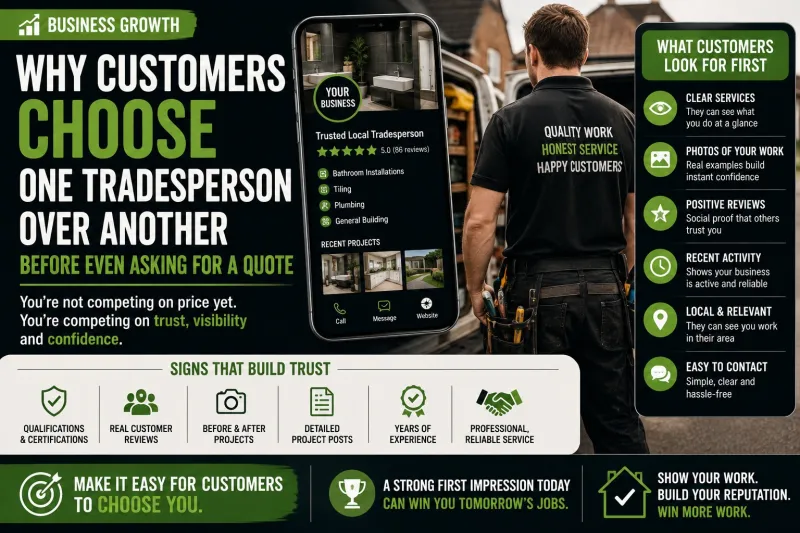
Here are some of the reasons customers choose one tradesperson over another before price even enters the conversation.1. They Understand What You Actually Do
This sounds obvious.
But many businesses make customers work far too hard to understand their services.
A customer shouldn't have to search through several pages, scroll through years of social media posts or send a message simply to find out whether you carry out the type of work they need.
If you specialise, say so.
If you cover several services, make them clear.
If there are particular jobs you regularly complete, show them.
A homeowner looking for a bathroom fitter doesn't necessarily want to guess whether "general building services" includes bathroom renovations.
The clearer you are, the easier it is for the right customers to recognise that you're relevant to their job.
And relevance is often the first hurdle.
Before a customer can choose you, they need to understand why they should consider you in the first place.2. They Can See Evidence of Your Work
Customers are naturally more confident when they can see what a tradesperson has actually done.
A list of services tells someone what you say you can do.
Previous work helps show what you have done.
That might include:
Before-and-after photos
Completed projects
Progress photos
Detailed explanations of the work
Examples of similar jobs
Specialist or particularly challenging projects
You don't need a professionally photographed portfolio containing hundreds of jobs.
Even regularly sharing genuine examples of your work can make a significant difference.
For a customer, evidence removes some of the uncertainty.
They can look at a completed project and think:
“That's similar to what I need.”
Or:
“I like the standard of that work.”
Or simply:
“This looks like a real, active business.”
That reassurance can be valuable before the first conversation even happens.3. Your Reputation Is Visible
Customers can't personally assess every tradesperson they find.
They haven't worked with you before.
They may not know anyone who has.
So they look for signals.
Reviews are one of the obvious examples.
But reputation can be communicated in other ways too.
Completed work.
Recommendations.
Qualifications and registrations where relevant.
How long a business has been active.
The consistency of its public information.
The way it communicates.
None of these things individually guarantee that someone is the right choice.
But together, they can help a customer feel more confident about making contact.
And confidence matters.
A customer is often inviting someone into their home, trusting them with an expensive project or relying on them to solve a problem they don't understand themselves.
The more uncertainty you remove before the conversation begins, the easier you may make the decision to contact you.4. You Look Active
Imagine a customer finds two businesses.
The first has recent examples of completed work, current information and signs that the business is actively operating.
The second has a website or profile that looks as though it hasn't been updated in years.
Even if both businesses are equally capable, the customer's perception may be very different.
People naturally want reassurance that a business is current.
That doesn't mean you need to post on social media every day.
And it doesn't mean constantly promoting yourself.
But occasional signs of activity can make a difference.
Share a completed project.
Update your services.
Add new photos.
Respond to reviews.
Keep your contact information accurate.
Show that the business behind the profile is still moving.
An active presence can create confidence that a customer is dealing with a real, established and engaged business.5. Your Photos Do Some of the Selling for You
Photos are often one of the first things customers notice.
They don't need to be perfect.
But they should help people understand your work.
A clear photograph of a finished bathroom tells a much stronger story than a paragraph claiming you provide "high-quality bathroom installations".
A before-and-after image can show the value of a renovation immediately.
A photo from a completed job can make a specialist service easier to understand.
Good photos don't necessarily mean expensive cameras, professional lighting or a photographer following you around.
They mean being deliberate about what you capture.
Before leaving a job you're proud of, take a moment to document it.
Over time, those individual photographs can become one of the strongest collections of evidence your business has.6. Customers Can Find the Information They Need Quickly
Every unnecessary step creates friction.
If someone has to search for your phone number, guess which areas you cover or send a message to ask whether you're available for a particular type of work, there's a greater chance they move on.
Make the basics easy to find.
Customers commonly want to know:
What services you provide
Where you work
How to contact you
Examples of previous work
Whether you appear established and trustworthy
Relevant qualifications or registrations where applicable
What other customers have said
You don't need to answer every possible question before someone contacts you.
But the basic information should be clear.
The easier you are to understand, the easier you are to consider.7. Professional Doesn't Mean Corporate
Some tradespeople hear "professional branding" and imagine expensive logos, polished advertising campaigns and perfectly curated social media.
That isn't what most customers are really looking for.
Professional can be much simpler.
Accurate information.
Clear communication.
Real photos.
A consistent business name.
Up-to-date contact details.
A profile that doesn't look abandoned.
Turning up when you say you will.
Responding to customers clearly.
For many people, professionalism is about reducing uncertainty.
They want to feel that if they contact you, they'll know who they're dealing with and what to expect.
You don't need to look like a national company.
You just need to make it easy for people to trust that you're a genuine business that takes its work seriously.8. You Make a Good First Impression Before You Speak
Your first interaction with a potential customer may not actually be a conversation.
It might be a Google result.
A business profile.
A project photo.
A review.
A recommendation.
A social media post.
That means your first impression is often working without you.
The customer is forming an opinion based on whatever information they can find.
This is particularly important because customers may be comparing several businesses in a short amount of time.
They aren't always conducting a detailed investigation into every option.
Sometimes, they're making quick decisions about which businesses feel worth contacting.
That doesn't mean you need to be everywhere online.
It means the places where your business does appear should represent you well.9. Price Usually Isn't the First Decision
Price matters.
Of course it does.
For most customers, the cost of a job will play an important role in the final decision.
But before you can compete on price, you often need to make it onto the customer's shortlist.
And that's where reputation, visibility and presentation can matter.
A customer might contact three tradespeople because those three gave them enough confidence to take the next step.
Another ten businesses may never get contacted at all.
Not because they were necessarily more expensive.
But because the customer couldn't easily find enough information to feel confident.
That's an important distinction.
Winning more work isn't only about winning the quote.
Sometimes it's about winning the opportunity to provide one.Your Online Presence Is Part of Your Reputation
For a modern trade business, your reputation increasingly exists in two places.
There is the reputation you build through the work itself.
And there is the reputation a potential customer can see before they've met you.
The two should support each other.
If you do excellent work, make sure there is evidence of it.
If customers leave positive feedback, don't let it disappear into an old message thread.
If you complete a project you're proud of, document it.
If your services change, update them.
If your business is growing, let your public presence grow with it.
You don't need to become a full-time marketer.
You don't need to post constantly.
And you don't need to create a polished advert every time you finish a job.
You simply need to avoid leaving your reputation entirely invisible.The Goal Is to Make Choosing You Feel Easier
Customers will always have questions.
They'll always want to compare options.
And not every customer will choose your business.
That's normal.
The goal isn't to convince everyone.
It's to make sure the right customers have enough information to confidently take the next step.
Can they understand what you do?
Can they see examples of your work?
Can they find evidence that others trust you?
Can they tell that your business is active?
Can they contact you easily?
If the answer is yes, you've already removed many of the reasons a customer might choose someone else before you've even had the chance to speak.
The work you do builds your reputation.
But the way you show that work determines whether new customers ever get the chance to discover it.
0 Comments
No comments yet — be the first to share your thoughts.