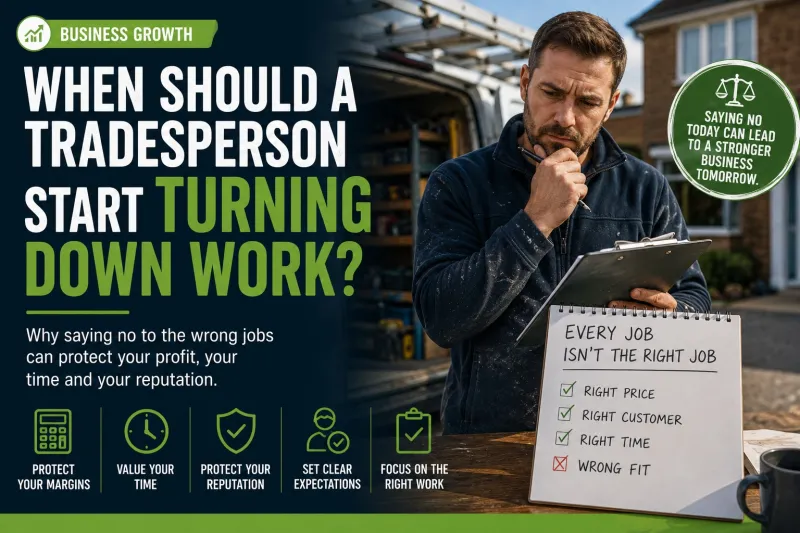
When Should a Tradesperson Start Turning Down Work?
For a tradesperson building a business, getting work is usually the first priority. A full diary means income. New customers mean opportunities. And when you're...
For a tradesperson building a business, getting work is usually the first priority.
A full diary means income.
New customers mean opportunities.
And when you're self-employed, the instinct can be to say yes whenever a job comes along.
But there comes a point where more work isn't necessarily better for the business.
Taking on the wrong jobs, at the wrong price or at the wrong time can leave a tradesperson working longer hours for less profit while putting pressure on the quality of their work.
Knowing when to say no can therefore be just as important as knowing how to win the next job.When the Numbers Don't Work
The most obvious reason to turn down a job is when the economics simply don't make sense.
A job might look worthwhile at first glance, but once you account for:
Materials
Labour
Travel
Parking
Waste disposal
Equipment
Time spent quoting
Administration
Unexpected delays
the actual return can be very different from the headline price.
It's easy to underestimate this when you're looking at a full diary and thinking about the total amount of money coming in.
But revenue isn't the same thing as profit.
A job that takes two days and leaves a healthy margin may be far more valuable than a three-day project that barely covers the costs involved.When the Customer's Expectations Don't Match the Job
Not every difficult customer is a bad customer.
People can be stressed, uncertain or simply unfamiliar with how trade work operates.
But there are situations where expectations become unrealistic from the beginning.
Perhaps the customer wants a premium result at the lowest possible price.
Perhaps they've requested work that isn't practical within their budget.
Or perhaps they've repeatedly changed what they want while expecting the original quotation to remain unchanged.
If expectations can't be aligned before the work starts, the situation rarely becomes easier once you're halfway through the job.
A clear conversation early on can sometimes resolve the issue.
If it can't, walking away may be better for both sides.When You're Taking Work Outside Your Expertise
Being capable and being qualified for a particular job aren't necessarily the same thing.
A tradesperson may be highly experienced in one area while having limited experience in another.
Taking on work simply because a customer has offered it can create unnecessary risk if it requires specialist knowledge, equipment or qualifications that you don't have.
There is nothing unprofessional about saying:
“That's not something we specialise in, but I can recommend someone who does.”
In fact, being honest about the limits of your expertise can strengthen your reputation.
A professional business doesn't need to claim it can do everything.When Your Diary Is Already Full
A full diary is a good problem to have.
But there is a difference between being busy and being overloaded.
If you're constantly squeezing jobs into gaps, working late into the evening and moving appointments around to fit everything in, the quality of the customer experience can eventually suffer.
Messages get answered later.
Quotes take longer.
Jobs take longer to complete.
Small mistakes become more likely.
And customers start waiting longer for updates.
At that point, accepting another job may actually damage the business rather than help it.
Sometimes the better option is to give the customer a realistic availability date.
They may be happy to wait.
And if they aren't, that's still better than promising a date you can't realistically meet.When the Job Could Damage Your Reputation
A trade business's reputation is built over time.
One poorly managed project can potentially undo a lot of good work.
If you already know that a particular project is likely to be difficult to deliver to the standard you normally expect, it's worth considering whether taking it on is sensible.
This doesn't mean avoiding every complicated job.
Some of the most rewarding projects are challenging.
The question is whether you have the time, resources, skills and commercial terms to deliver the result you're promising.
If you don't, saying no before the work begins may be much better than disappointing the customer afterwards.When the Customer Wants You to Cut Corners
This is one of the clearest reasons to walk away.
If a customer is asking you to ignore regulations, use unsuitable materials, skip necessary work or carry out something you aren't comfortable signing off, the potential consequences can go far beyond losing a job.
Professional standards exist for a reason.
Your reputation, insurance, qualifications and potentially your ability to continue working can all be affected by decisions made on individual jobs.
A customer's budget doesn't remove your professional responsibilities.When the Travel Doesn't Make Sense
Travel is another cost that can easily disappear from the calculation.
A job that looks profitable on paper may become much less attractive when it involves significant travel, fuel, parking and unpaid time.
This is particularly relevant for businesses that normally operate within a defined local area.
There may occasionally be a good reason to travel further for a specialist or particularly valuable project.
But if you're regularly spending hours travelling between jobs, it's worth asking whether the work is actually contributing to the business in the way you think it is.When You're Saying Yes Because You Feel You Have To
Perhaps the hardest job to turn down is the one you could technically do but simply don't want to take.
When you're self-employed, it can be difficult to say no.
There is always another bill.
Another quiet period could come along.
Another customer might be difficult to replace.
But building a sustainable business means thinking beyond the next invoice.
If every job you accept leaves you exhausted, frustrated or working for margins that don't justify the effort, eventually something has to change.
Being selective doesn't mean becoming difficult to work with.
It means understanding what kind of work makes sense for your business.Saying No Doesn't Have to Mean Losing the Customer
Turning down a job doesn't necessarily mean ending the relationship.
A professional response can explain that you're unavailable, that the project falls outside your normal area of work or that another specialist would be better suited.
Where appropriate, you may even be able to recommend another tradesperson.
That can leave the customer with a positive impression despite the fact that you didn't take the job.
And sometimes that customer may come back to you later with a project that is a much better fit.A Full Diary Isn't Always the Goal
It's easy to measure a trade business by how busy the calendar looks.
But a completely full diary doesn't automatically mean a successful business.
The more useful questions are:
Are the jobs profitable?
Can you complete them to the standard you expect?
Are customers receiving a professional experience?
Are you charging enough for the work involved?
Do you still have time to run the business properly?
Is the work sustainable?
If the answer to several of these is no, simply finding more work isn't necessarily the solution.
Sometimes the solution is becoming more selective about the work you accept.The Right Work Is More Valuable Than More Work
Turning down work can feel like a step backwards when you're trying to grow.
But there is a difference between rejecting opportunities and protecting the business you've already built.
The strongest trade businesses aren't necessarily the ones that say yes to everything.
They're often the ones that understand their strengths, know what their work is worth, set realistic expectations and choose projects they can deliver properly.
Being busy can keep a business moving.
Taking on the right work is what can help keep it healthy.
0 Comments
No comments yet — be the first to share your thoughts.