How to Follow Up a Quote Without Chasing the Customer Away
You visit a property. Discuss the job. Take measurements. Work out the materials. Spend an evening preparing the quotation. Send it across. And then... Nothing....
At that point, plenty of tradespeople simply move on.
Others start chasing.
“Hi, did you get my quote?”
Two days later:
“Just checking whether you've made a decision?”
Then:
“I need to know because my diary is filling up.”
There is a better middle ground.
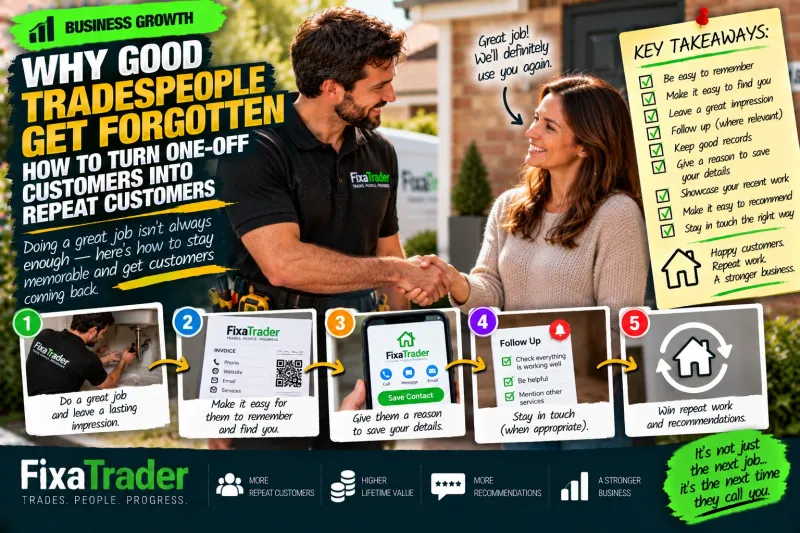
Following up doesn't have to mean pressuring somebody into accepting your quotation.
Done properly, it is simply part of good communication.Why Customers Don't Always Reply
Silence doesn't automatically mean the customer has chosen somebody else.
They may still be gathering quotations.
They might need to discuss the cost with their partner.
The project could have been delayed.
They may be waiting for payday or finance.
Something more urgent may have happened.
They might have a question they haven't got around to asking.
Or, yes, they may have decided not to proceed.
The problem is that you don't know which one applies.
A polite follow-up gives them an opportunity to tell you.Following Up Isn't the Same as Chasing
There is an important difference between:
“Just wanted to check you've received the quotation and see if there are any questions I can answer.”
and:
“Are you going ahead? I need an answer today.”
The first opens the conversation.
The second creates pressure.
Unless there is a genuine deadline that has already been communicated, customers shouldn't feel as though they're being forced to make an immediate decision.
Your goal isn't to extract a yes.
It's to make it easy for them to take the next step.When Should You Follow Up?
There isn't a perfect number of days for every business.
A £150 repair and a £40,000 renovation don't have the same decision-making process.
For relatively straightforward work, following up after a few working days may be reasonable.
For larger projects involving multiple quotations and substantial expenditure, customers may need considerably longer.
The important thing is to avoid following up so quickly that the customer hasn't had a reasonable opportunity to consider what you've sent.
If you send the quotation at 7pm on Monday, they probably don't need:
“Any thoughts?”
at 8am Tuesday.
Give people some room.Make Sure They Actually Received It
Before assuming you've been ignored, establish that the quotation arrived.
Emails go into spam folders.
Attachments fail.
Addresses get entered incorrectly.
Customers overlook messages.
Your first follow-up can therefore be extremely simple:
Hi Sarah, just checking that the quotation I sent over on Tuesday reached you okay. No rush — if you've got any questions about anything included, just let me know.
That's useful without being pushy.
It confirms delivery and gives the customer an obvious reason to reply.Don't Just Ask “Have You Decided?”
A good follow-up should provide some value.
Instead of repeatedly asking whether the customer wants the job, give them an opportunity to resolve uncertainty.
For example:
Just checking in regarding the bathroom quotation. If you'd like me to clarify anything around the materials, timescale or what's included in the price, I'm happy to run through it.
That can uncover the real reason the customer hasn't responded.
Maybe they don't understand whether decorating is included.
Maybe they're unsure which tiles they need to purchase.
Maybe another quotation includes something yours doesn't.
Without asking, you may never know.Make Your Original Quote Easy to Understand
Sometimes the problem isn't the follow-up.
It's the quotation.
If the customer receives:
Bathroom works – £6,850
they may have plenty of unanswered questions.
Does that include materials?
Waste removal?
Plumbing?
Tiling?
VAT?
Fixtures?
Making good?
How long will it take?
When can you start?
A clear quotation removes many of those uncertainties before the follow-up is ever needed.
The easier your quote is to understand, the easier it is for somebody to make a decision.Don't Immediately Offer a Discount
A customer hasn't replied for four days.
The temptation is to send:
“I can knock £500 off if that helps.”
But you don't even know whether price is the issue.
Perhaps they haven't read the quotation yet.
Perhaps they're perfectly comfortable with the price but aren't ready to start.
Perhaps you're already their preferred contractor.
Discounting before the customer has raised a price objection can unnecessarily reduce the value of the job.
It can also make the original price look less credible.
If budget genuinely becomes an issue, there may be a conversation to have about scope, specification or alternatives.
That's different from automatically cutting the price because somebody hasn't replied.Use Genuine Availability Carefully
Your diary can be relevant.
If you originally told the customer you had availability during a particular week and that space is now close to being booked, it is reasonable to update them.
For example:
Just a quick update — when we spoke I mentioned I had availability during the week beginning 5 October. I've now had another enquiry for that week, so if those dates are important to you, let me know and I can confirm what's still available.
That's information.
What you want to avoid is manufactured urgency:
“LAST SLOT AVAILABLE — BOOK TODAY.”
If it isn't true, don't say it.
Professionalism builds more trust than sales tactics.Keep Records of Your Quotes
If you're sending several quotations every week, relying on memory quickly becomes difficult.
Keep track of basic information such as:
Customer.
Job.
Date quoted.
Quotation value.
Whether you've followed up.
Outcome.
You don't need an elaborate system when you're small.
A spreadsheet, CRM or quotation-management tool can be enough.
The objective is simply to avoid good enquiries disappearing because everybody forgot about them.One Follow-Up Can Be Enough
Not every unanswered quote needs a campaign.
If you've sent the quotation, confirmed they received it and followed up appropriately, there comes a point where the customer needs to make their own decision.
Repeated messages can turn a positive impression into an irritating one.
A final message might simply say:
No problem if your plans have changed. I'll leave this with you, but if you'd like to revisit the work later, feel free to get back in touch.
Then move on.
The door stays open without you continuing to chase somebody who isn't responding.Ask for Feedback When You Lose the Job
Sometimes the customer replies:
“Thanks, but we've decided to use somebody else.”
That's disappointing.
But it can also be useful.
Where appropriate, you could respond:
Thanks for letting me know. No problem at all. If you don't mind me asking, was there anything in particular that influenced the decision? Feedback is always useful for us.
Don't argue with their answer.
Don't try to prove the other contractor is worse.
And don't make the customer justify themselves.
If they choose to give feedback, listen.
Over time, patterns can become valuable.Price Isn't Always Why You Lost
Tradespeople can naturally assume:
“Someone undercut me.”
Sometimes that's exactly what happened.
But customers choose contractors for plenty of other reasons.
Another business may have:
Responded faster.
Explained the work more clearly.
Had earlier availability.
Provided a more detailed quotation.
Shown stronger examples of similar projects.
Had better reviews.
Communicated more confidently.
Or simply made the customer feel more comfortable.
That is why tracking lost quotations can teach you more than simply tracking the jobs you win.Work Out Your Quote Conversion Rate
Suppose you send 20 quotations.
Five become jobs.
That means 25% converted.
Is that good?
It depends on the type of work, how enquiries are generated, your pricing and many other factors.
But once you begin tracking the number, you have something to compare.
Perhaps you make your quotations clearer.
Start following up consistently.
Improve your portfolio.
Collect more reviews.
Three months later, 8 of every 20 quotes become jobs.
You haven't generated a single additional enquiry.
You've simply converted more of the opportunities you already had.
That can have a substantial effect on a business.Not Every Quote Should Become a Job
A 100% quotation conversion rate isn't necessarily the objective.
Some customers aren't the right fit.
Some jobs don't suit your business.
Some budgets are unrealistic.
Some schedules don't work.
And sometimes another contractor is simply a better choice for that particular project.
You aren't trying to win everything.
You're trying to avoid losing good work unnecessarily because communication stopped after the quotation was sent.Follow-Up Starts Before You Leave the Property
One of the easiest improvements is setting expectations during the initial visit.
Instead of:
“I'll send you something over.”
try:
“I'll get the written quotation across by Thursday. Have a look through it and I'll check in early next week in case you've got any questions.”
Now the customer knows:
When the quote is coming.
That you're going to follow up.
And why you're following up.
The later message doesn't feel like chasing.
It's simply what you said you'd do.Professionalism Continues After the Quote
A customer is still evaluating you after you've left their property.
How quickly you send the quotation matters.
How clearly it is written matters.
Whether you do what you said you'd do matters.
And how you communicate afterwards matters.
The physical work hasn't started yet, but the customer is already getting an impression of what working with your business might be like.
A professional follow-up reinforces that impression.Send the Quote. Follow Up. Then Let the Customer Decide.
There is nothing wrong with wanting an answer.
You invested time in assessing and pricing the work.
But the best follow-up doesn't demand a decision.
It removes obstacles to one.
Confirm the quotation arrived.
Offer to answer questions.
Provide genuine updates where relevant.
Keep track of the opportunity.
Then know when to leave it alone.
Following up isn't about chasing every customer until they say yes.
It's about making sure a good opportunity doesn't become a lost job simply because nobody restarted the conversation.
0 Comments
No comments yet — be the first to share your thoughts.